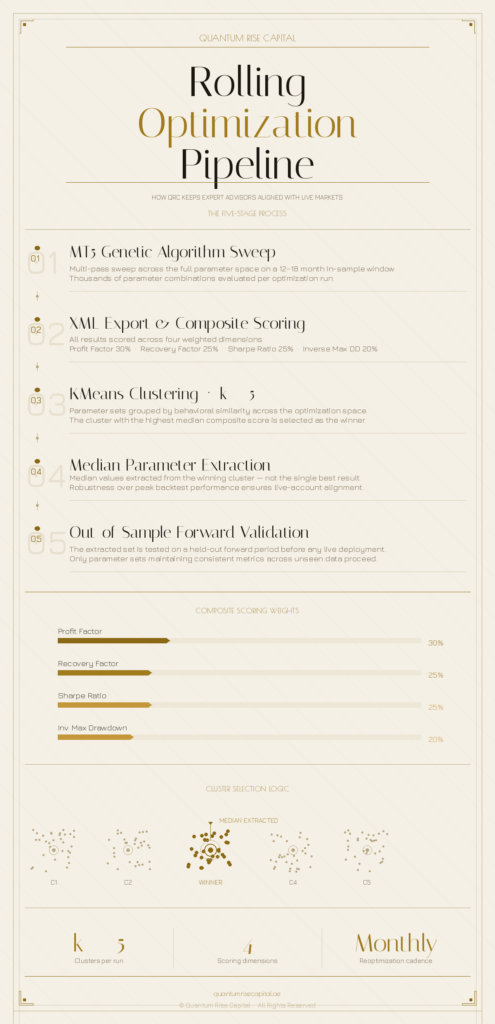
Rolling Optimization Concept: How to keep your EA alive with ever changing markets.
Every algorithmic trader faces the same quiet crisis: an Expert Advisor that back tested beautifully slowly drifts out of sync with the market. The parameters that generated exceptional Sharpe ratios in 2023 produce drawdown in 2024. The fix most traders reach for another back test, another tweak is the same mistake made twice. The problem was never the parameters. It was treating them as permanent.
At Quantum Rise Capital, we built our entire EA development methodology around one principle: markets are non-stationary, so optimization must be continuous. This article explains our rolling optimization pipeline the same system underpinning every QRC Expert Advisor and why it produces EAs that adapt rather than decay.
The Static Parameter Problem
Most retail EA developers optimize once. They run a backtest over historical data, identify the parameter set with the highest profit factor or net profit, and ship it. Some add walk-forward validation. Fewer add Monte Carlo stress testing. Almost none revisit the parameters once the EA is live because that would mean acknowledging that the first optimization was, at best, a snapshot.
A snapshot of what? Of a specific volatility regime. A specific correlation structure between assets. A specific macro environment. When any of those change and they always change the static EA has no way to respond. It executes the same signals with the same thresholds into fundamentally different market conditions.
“A parameter set is not a discovery. It is a measurement. And like all measurements, it has an expiry date.”
The result is the familiar live-versus-backtest divergence that has ended more prop firm challenges than any single bad trade. It is not bad luck. It is a structural flaw in how the EA was built.
The Rolling Optimization Framework
QRC’s answer is a three-stage pipeline that runs on a defined cadence typically monthly for swing-oriented systems, more frequently for scalping EAs. Rather than searching for the single best parameter set, we search for the cluster of parameter sets that performs most consistently across varied market conditions within the recent lookback window.
The five stages are:
01 – MT5 Genetic Algorithm Optimization A multi-pass genetic algorithm sweep across the full parameter space, run on the most recent in-sample window (typically 12–18 months). Each pass generates thousands of parameter combinations, evaluated against a composite fitness function weighting Profit Factor, Recovery Factor, Sharpe Ratio, and maximum drawdown.
02 – XML Export & Composite Scoring All optimization passes are exported from MT5 as XML and ingested into our Python scoring engine. Each result receives a composite score: Profit Factor (30%), Recovery Factor (25%), Sharpe Ratio (25%), and inverse maximum drawdown (20%). This surfaces results that are not just profitable but stable and risk-adjusted.
03 – KMeans Clustering (k = 5) The scored results feed into a KMeans clustering algorithm with k=5. This groups parameter combinations by behavioral similarity EAs that produce comparable equity curves cluster together regardless of surface-level parameter differences. We then identify the winning cluster: the group with the highest median composite score.
04 – Median Parameter Extraction From the winning cluster, we take the median value for each parameter not the single best performer. The median represents the center of gravity of a robust parameter neighborhood, not an outlier that happened to back test well. This is the set deployed to live accounts.
05 – Out-of-Sample Forward Testing The extracted parameter set is validated on a held-out out-of-sample period before any live deployment. Only sets that maintain consistent metrics on unseen data proceed. The cycle then resets on the next scheduled cadence with the latest market data.
Why KMeans and Not the Best Single Result?
The instinct when looking at optimization results is to take the top performer. But in a genetic algorithm sweep with tens of thousands of passes, the single best result is almost always an outlier a parameter combination that perfectly fit the idiosyncrasies of the in-sample period. Put it live and you have not found the optimal strategy. You have overfit a back test.
KMeans clustering shifts the question from “which set performed best?” to “which neighborhood of parameter space is most densely populated with good performers?” A cluster of 400 results all scoring 0.74–0.82 is far more trustworthy than a single result scoring 0.91 in isolation. The median of that cluster is not the peak it is the center of a robust zone. It represents parameter stability rather than parameter luck.
Regime Intelligence and Parameter Adaptation
Rolling optimization handles macro-level parameter drift. But markets also shift on shorter timescales between trending and mean-reverting regimes, between low and high volatility environments. Several QRC EAs include a regime intelligence layer that dynamically adjusts thresholds within the deployed parameter set without requiring a full re-optimization cycle.
On QRC DailyGrid (US30, M15), for example, the regime layer uses ADX, ATR, and RSI readings to classify the current market state as trending, ranging, or transitional, then applies regime-specific entry and grid spacing thresholds accordingly. The result is an EA that not only starts from a robustly optimized parameter set it continuously adjusts its behavior based on what the market is doing right now.
This two-layer approach — periodic rolling re-optimization at the macro level, regime detection at the micro level is what separates adaptive algorithmic trading from static rule execution dressed up in code.
What This Means for Prop Firm Traders
If you are attempting a prop firm challenge FTMO or any equivalent the rolling optimization model offers a structural advantage that static EAs cannot match. Prop firm evaluation windows are typically 30–60 days. A freshly reoptimized EA, calibrated on the most recent 12–18 months of market data, enters that window with parameter relevance that a once-optimized EA simply does not have.
More critically, prop firm challenges fail most often not on single bad trades but on steady drawdown accumulation the slow bleed that comes from an EA executing signals that no longer fit the current regime. Rolling optimization directly reduces this risk by ensuring the EA’s core behavior is calibrated to conditions as close to the present as the optimization cadence allows.
QRC’s EA suite was built with FTMO compliance in mind: hard-coded maximum daily loss limits, equity-based lot sizing, and static drawdown watchdogs are standard architecture across all systems. Rolling optimization is the layer that keeps those safety parameters from becoming the last line of defense against an EA that has drifted out of sync with the market.
Building Your Own Rolling Optimization Process
You do not need QRC’s infrastructure to implement rolling optimization. The core requirements are: MT5 with the Strategy Tester, a consistent optimization schedule, and a method for selecting parameter sets that prioritizes robustness over peak backtest performance.
The minimum viable version: monthly in-sample optimization → composite scoring across at least profit factor and maximum drawdown → selection of a parameter set that ranks consistently rather than peaks exceptionally → out-of-sample validation before any live deployment. KMeans clustering adds significant analytical depth, but even without it, selecting for robustness over peak performance dramatically improves live-account alignment.
The discipline is in the cadence. Set a calendar reminder. Run the optimization. Do not skip it because last month’s parameters are “still working.” By the time you notice they have stopped working, you are already in drawdown.
Rolling optimization is not a trading edge in itself. It is the maintenance layer that keeps a genuine edge operational across changing market conditions. Every QRC Expert Advisor ships with this methodology embedded in its development history — not as a feature to market, but as the baseline expectation for how a serious algorithmic trading system should be built and sustained.
