There is no shortage of LinkedIn posts promising that MT5 and AI will revolutionize retail algorithmic trading. Slap a neural network on a chart, add a transformer for good measure, and watch the equity curve go vertical. The reality inside MetaTrader 5 is quieter, more constrained, and if you are honest about the tradeoffs far more useful than the marketing suggests.
At QRC we ship Expert Advisors that run in production on prop firm accounts and live broker accounts. That means every design decision has to survive contact with latency, spread, slippage, broker feed quirks, and the FTMO rulebook. AI has a real role in that stack. It also has real limits. This post is an honest map of both.
What MT5 Actually Gives You
Before talking about AI, it helps to remember what MT5 is. It is a tick-driven execution platform with a proprietary language (MQL5), a strategy tester that supports genetic optimization over millions of parameter combinations, and crucially for this discussion support for ONNX model inference natively inside MQL5, plus the ability to bridge to Python via sockets, files, named pipes, or the official MetaTrader5 Python package.
That gives you three practical paths for putting AI into an EA:
- Train offline in Python, export to ONNX, run inference inside MQL5. This is the cleanest production path. Your EA stays self-contained, tick-by-tick latency is negligible, and the model is frozen in a format the terminal can execute without external dependencies.
- Run a Python process alongside the terminal and pipe features back and forth. More flexible, higher latency, more things that can break. Useful for research and for strategies where inference happens once per bar rather than per tick.
- Use ML-flavoured logic written directly in MQL5. KNN, basic clustering, decision rules things you can hand-code without a framework. Not glamorous, but it runs everywhere and has zero external dependencies.
Each of these is a real tool. None of them is a magic wand.
Where AI Genuinely Earns Its Place
After building out the QRC EA suite and running the full optimization workflow on every one of them genetic search, KMeans clustering of the parameter space on a weighted composite score, then forward testing on out-of-sample data a pattern becomes clear about where machine learning actually helps.
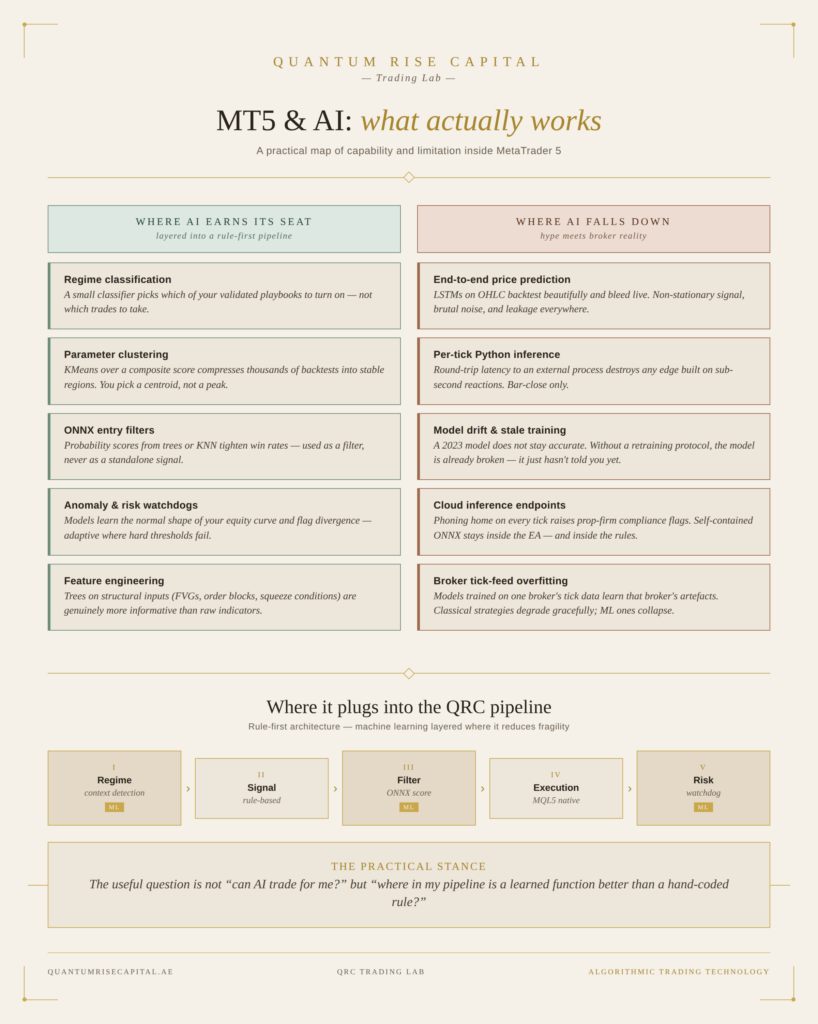
Regime classification. Markets do not behave the same way in a low-volatility drift as they do in a news-driven breakout or a mean-reverting range. A small classifier trained on features like ATR percentile, ADX, realised volatility, and recent return distribution can tell you which playbook to run. This is not the AI picking trades; it is the AI picking which of your already-validated strategies to turn on. That distinction matters.
Parameter clustering and selection. A genetic optimizer will happily hand you 5,000 “profitable” backtests, most of which are curve-fit noise. KMeans over a composite score profit factor, recovery factor, Sharpe, inverse drawdown compresses that cloud into a handful of stable regions. You pick a centroid, not a peak. This is how you avoid deploying a parameter set that works beautifully in-sample and dies the moment the market shifts.
Feature engineering for entries. Models like KNN on pivot-level features, or a small gradient-boosted tree on structural inputs (FVGs, order blocks, squeeze conditions), can produce probability scores that are genuinely more informative than a raw indicator reading. Used as a filter not as a standalone signal they tighten win rates without inventing trades out of nothing.
Anomaly and risk detection. ML is unreasonably good at noticing when “things look different now.” A drawdown watchdog that learns the normal shape of your equity curve and flags divergence is a better risk tool than a hard percentage threshold, because it adapts to the strategy rather than the other way around.
That is a meaningful list. Used properly, AI makes your EA more context-aware, more robust to parameter fragility, and better at knowing when to stand down.
Where AI Falls Down in MT5
Now the honest part.
End-to-end neural models do not work the way retail traders want them to. Train an LSTM on OHLC data, predict the next bar, wire it to an EA the back test looks incredible, the live account bleeds. This happens because financial time series are non-stationary, the signal-to-noise ratio is brutal, and most of what the model “learned” was leakage: look-ahead in your feature engineering, survivorship in your data, regime accident in your training window. MT5 does not cause this problem, but it does not save you from it either.
Inference latency matters more than people admit. ONNX in MQL5 is fast, but if you are calling out to a Python process on every tick, you have just introduced a round-trip that will destroy any edge built on sub-second reactions. For bar-close strategies this is fine. For scalping, forget it.
Retraining is an operational problem, not a technical one. A model trained on 2023 data does not stay accurate forever. Drift is real. Who retrains it, on what schedule, with what validation protocol? If the answer is “I’ll get to it,” the model is already broken. This is why at QRC we lean on rolling optimization a disciplined, repeatable process rather than a single trained model that gradually rots.
Prop firms treat AI-heavy EAs with suspicion. Most of the better firms, FTMO included, are fine with EAs in general, but anything that looks like HFT, latency arbitrage, or externally-fed signal generation raises compliance flags. A self-contained ONNX model running inside your EA is defensible. A Python bridge that phones home to a cloud inference endpoint on every tick is a conversation you do not want to have with a risk desk.
Broker feed differences will eat ML edges faster than classical ones. A strategy built on classical indicators tends to degrade gracefully across brokers. A strategy built on a model trained on one broker’s tick data can fail completely on another, because the features the model learned were partly artefacts of that specific feed.
The Practical Stance
The useful way to think about AI in MT5 is not “can it trade for me” but “where in my pipeline is a learned function better than a hand-coded rule?” For regime detection, parameter selection, and risk monitoring, the answer is often yes. For entry and exit timing on its own, the answer is almost always no not because the models are bad, but because the problem is harder than the models pretend it is.
The EAs we run in production are not AI-first. They are rule-first, with machine learning layered in where it genuinely reduces fragility. Genetic optimization for search, KMeans for parameter robustness, the occasional classifier for context and a lot of forward testing before anything touches a funded account.
That is less exciting than “AI trading bot.” It is also what actually works.
