A rigorous, engineer-grade framework for separating real edge from curve-fitted illusion before you learn the difference the expensive way.
QRC Research · April 2026 · 9 Min Read
There is a quiet tragedy that unfolds thousands of times every month across the retail algorithmic trading world. A trader buys an Expert Advisor. The back test is stunning 94% win rate, equity curve like a staircase, drawdown under 3%. They demo it for two weeks. It performs. They pay a $500 prop firm challenge fee, load the EA onto a funded-sized account, and within eleven trading days the account is dead.
The EA was not broken. The back test was not faked. The trader did nothing obviously wrong. What happened is more subtle, and more common: the EA was never robust in the first place. It was fit beautifully, convincingly fit to a specific slice of historical data, and when reality diverged from that slice by even a small amount, the edge evaporated.
The frustrating part is that this is preventable. The tools to diagnose a fragile EA are available to anyone with MetaTrader 5 and a few hours of discipline. What is missing, almost everywhere, is a structured framework for applying them. This article provides that framework five tests that together separate a system with a real, transferable edge from one that simply memorized the past.
A Cautionary Tale
A trader we’ll call Marco buys a popular EA from the MQL5 marketplace. Its back test shows 847 trades over four years, a profit factor of 2.8, and a maximum drawdown of 4.1%. The reviews are glowing.
Marco runs it on a demo account for two weeks. It takes 14 trades and wins 13. He is satisfied. He purchases a $100,000 FTMO two-step challenge for $540, loads the EA with the vendor’s recommended settings, and goes to sleep.
Over the next eight trading days the EA takes 31 trades. It wins 18 and loses 13 still a positive ratio. But the losers are roughly three times the size of the winners. On day nine, a cluster of four losses in the London session pushes the account past FTMO’s 10% maximum drawdown. The challenge is failed. The $540 is gone.
Every single one of the five tests below would have flagged this EA before Marco spent a dollar.
Why Backtests Lie
A standard MT5 back test answers exactly one question: given this specific historical price series, and these specific parameters, what would the P&L have been? It is a measurement, not a prediction. The problem is that retail traders and many EA vendors treat it as the latter.
The transformation from measurement to prediction requires a leap of faith: the assumption that the future will resemble the past closely enough that the measured performance will persist. Robustness testing is the discipline of stress-testing that assumption. It does not guarantee the future. It guarantees only that the EA’s edge is not a statistical accident of the particular past you back tested against.
Each of the five tests below attacks a different failure mode. An EA that passes all five has not proven it will make money going forward. It has proven something weaker, but still valuable: that its historical performance is structurally sound rather than coincidental.
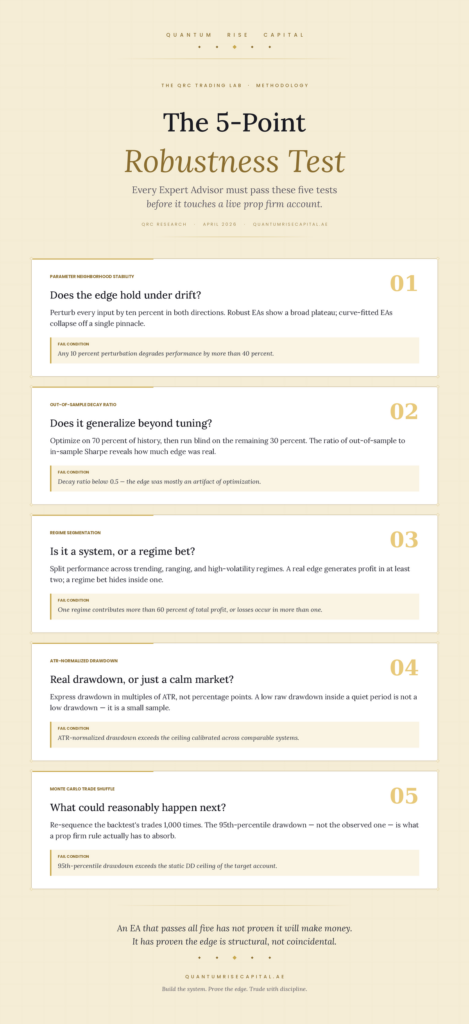
What are the 5 points Robustness Test Every EA Must Pass Before You Risk a Prop Firm Fee ?
Test 01 — Parameter Neighborhood Stability
Take every tunable input in the EA the RSI period, the ATR multiplier, the stop-loss distance and perturb each one by ten percent in both directions. Re-run the back test at each perturbed setting. You now have a picture of how the EA behaves not at a single point in parameter space but across a small neighborhood around that point.
A genuinely robust EA degrades gracefully. If the profit factor at the “optimal” setting is 2.1, the perturbed settings should produce profit factors roughly in the range of 1.7 to 2.4. A curve-fitted EA behaves completely differently: the optimal setting shows 2.1, and the ±10% perturbations collapse to 0.9, 1.1, 0.8. The profit is sitting on a pinnacle, and any drift in live conditions spread widening, broker latency, small parameter misconfiguration will push it off.
At QRC, we visualize this as a three-dimensional surface across two parameters. Robust systems produce a broad plateau. Overfitted systems produce a single sharp spike surrounded by loss.
Fail condition: Performance at any ±10% perturbation degrades by more than 40% relative to the central setting.
Test 02 — Out-of-Sample Decay Ratio
Split the historical data into two periods: an in-sample window used for optimization, and an out-of-sample window that the EA has never seen during tuning. A common split is 70/30, oldest data first. Optimize on the in-sample period, then run the resulting parameters blind on the out-of-sample period.
Now compare the Sharpe ratio or profit factor, if you prefer between the two periods. The out-of-sample figure will almost always be lower than the in-sample figure. That is expected and unavoidable, a consequence of optimization itself. What matters is how much lower.
The ratio of out-of-sample Sharpe to in-sample Sharpe is the decay ratio. A robust EA typically lands between 0.6 and 0.9. Anything below 0.5 indicates the in-sample performance was significantly driven by artifacts that did not generalize. Anything above 1.0 is suspicious for a different reason it suggests the out-of-sample window happened to be unusually favorable, which is its own form of luck masquerading as robustness.
Fail condition: Decay ratio below 0.5. The EA’s in-sample edge is largely an artifact of the optimization process.
Test 03 — Regime Segmentation
Markets are not homogenous. A given asset will spend weeks in strong directional trends, then months in tight ranges, then brief eruptions of high volatility. An EA that performs beautifully across a four-year back test may have earned every dollar during the trending regime and simply broken even during the ranging and volatile regimes or worse, lost money in one and more-than-compensated in another.
That kind of EA is not robust. It is a regime bet dressed up as a system. The moment the market shifts into the regime that didn’t generate its profit, performance collapses.
Segment the backtest into three buckets: trending, ranging, and high-volatility periods. A simple classifier using ADX for trend strength and ATR percentile for volatility is sufficient. Measure profit factor and drawdown independently in each regime. A robust EA shows positive expectancy in at least two of the three regimes, with no single regime contributing more than 60% of total profit.
Fail condition: One regime accounts for more than 60% of total profit, or the EA loses money in more than one regime.
Test 04 — ATR-Normalized Drawdown
Raw drawdown numbers lie by omission. A 4% max drawdown on EURUSD during a calm 2019 backtest is not comparable to a 4% max drawdown on GBPUSD during the 2022 volatility regime. The first is a meaningful result. The second may simply mean the EA happened to trade a period where the instrument’s natural range was unusually narrow.
The fix is to express drawdown in units that normalize across volatility conditions. ATR-normalized drawdown divides the observed maximum drawdown by the average true range of the instrument over the same period, producing a figure in “ATR multiples” rather than percentage points.
This metric travels. A robust EA on a volatile index like NAS100 and a robust EA on a calm pair like EURCHF should produce ATR-normalized drawdown figures in the same rough range. When an EA shows a low percentage drawdown but a high ATR-normalized drawdown, you have learned something important: the drawdown was only small because the market happened to be small. When the market wakes up, the drawdown will too.
Fail condition: ATR-normalized drawdown exceeds a value you haven’t calibrated against comparable systems. At QRC, our internal ceiling for prop-firm-deployable EAs sits below 18 ATR multiples across a full four-year backtest.
Test 05 — Monte Carlo Trade Shuffle
The maximum drawdown your back test reports is a single observation. The trades happened in a specific order. Had the same set of trades arrived in a different order which is entirely possible in live trading, because the market does not owe you your back test’s sequencing the maximum drawdown could easily have been two or three times larger.
Monte Carlo trade shuffling addresses this by taking the full list of trade results from the backtest and randomly re-sequencing them one thousand times. Each re-sequencing produces a different equity curve and a different maximum drawdown. What you end up with is a distribution of possible drawdowns consistent with your EA’s trade characteristics.
The number that matter is not the mean of this distribution. It is the 95th percentile the drawdown figure that ninety-five percent of shuffled sequences stayed below. That is the drawdown a prudent trader should plan around. If the observed back test drawdown was 6% but the 95th-percentile shuffle drawdown is 14%, the correct answer for a prop firm challenge with a 10% static drawdown limit is that the EA will probably blow the account not because its edge is fake, but because its natural drawdown distribution does not fit inside the rule.
Fail condition: 95th-percentile Monte Carlo drawdown exceeds the static drawdown ceiling of the prop firm account you intend to run the EA on.
An EA that passes all five tests has not proven it will make money. It has proven that its edge is structural, not coincidental. Those are very different things and only one of them survives contact with a live account.
Reading the Results Together
The tests are not independent. A failure on test two often shows up as degradation across test one. A pass on test three but failure on test four usually means the EA handles regime shifts fine, but its drawdown has been artificially suppressed by testing in a quiet volatility environment. The five tests form a diagnostic grid, not a checklist.
What you are looking for is a coherent story across all five. The robust EA is the one that shows a broad parameter plateau, a clean out-of-sample decay, distributed profit across regimes, drawdown that remains contained when normalized against volatility, and a Monte Carlo distribution whose 95th percentile still fits comfortably inside the risk rules of the account you plan to run it on. Every one of those conditions tells you something different. Together, they tell you the EA has earned its deployment.
Why This Matters Doubly for Prop Firms
A retail account is forgiving. If your EA drawdowns 15% before recovering, you are annoyed, but the account is intact and the strategy continues. A prop firm account is not forgiving. FTMO’s static 10% maximum drawdown does not care whether the excursion was temporary or whether the EA would have recovered within a week. The moment the equity line crosses the threshold, the account is dead and the fee is gone.
This asymmetry is why prop firm deployment deserves a higher bar of diligence than live retail deployment. Tests four and five in particular ATR-normalized drawdown and Monte Carlo shuffle are non-negotiable before any EA touches a challenge account. The back test drawdown is what would have happened once. The Monte Carlo 95th percentile is what could reasonably happen next time. A static drawdown rule is a hard wall against the second number, not the first.
The QRC Robustness Checklist
- Parameter neighborhood stability: ±10% perturbation degrades performance by less than 40%
- Out-of-sample decay ratio between 0.6 and 0.9
- Positive expectancy in at least two of three market regimes
- No single regime contributes more than 60% of total profit
- ATR-normalized drawdown within the acceptable band for comparable systems
- Monte Carlo 95th-percentile drawdown fits inside prop firm rules with margin
A Final Word
The five tests described here are the minimum bar every system inside the QRC product line must clear before it is considered for live deployment, on our capital or on a funded account. We apply them not because they are exotic but because they are the honest cost of knowing, rather than hoping, that an edge is real.
If you build your own EAs, run your next one through this framework before you deploy it. If you buy EAs, demand to see these numbers before you pay for the next challenge fee. A vendor who cannot produce them has not done the work. A vendor who can and who publishes them openly has given you the single thing the retail EA market is almost entirely missing: a reason to trust the number on the equity curve.
Every EA in the QRC product line is built against this framework. Explore the methodology and the systems at quantumrisecapital.ae
