5 Key Impacts of War on Trading: The View From Abu Dhabi
how war is pricing every major trading pair ? Most macro commentary on the Middle East conflict is being written from London desks and New York newsrooms. From here in the UAE, the picture is sharper — and it tells a different story than the headlines.
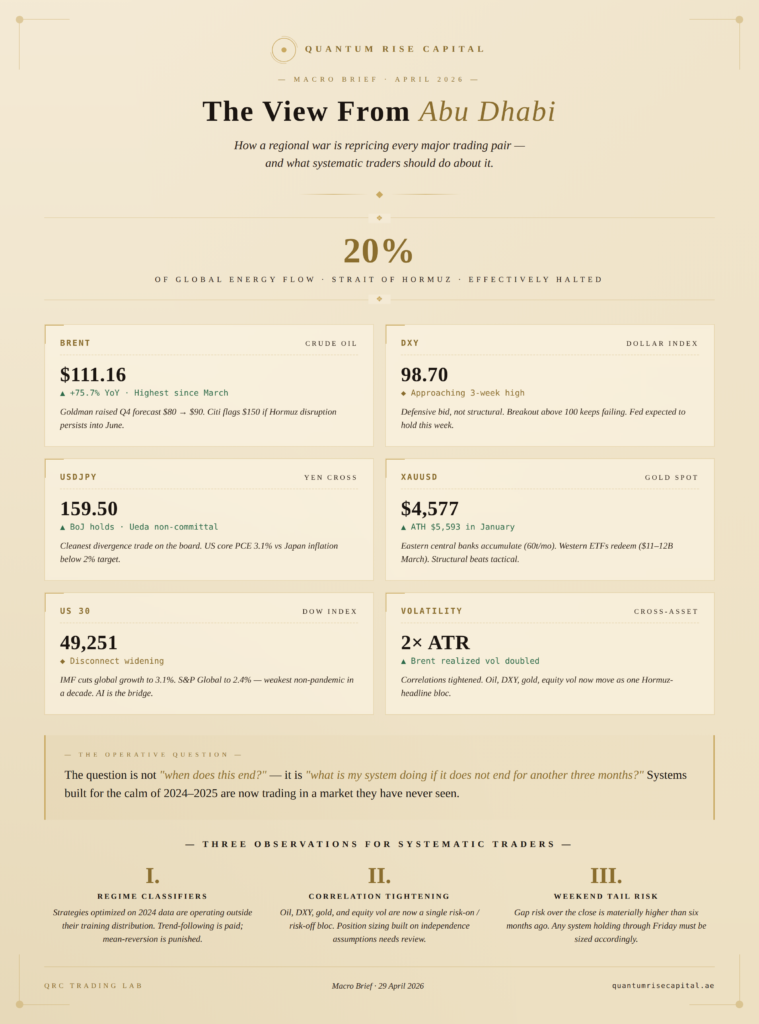
We are nine weeks into a regional war. The Strait of Hormuz — through which roughly 20% of global energy passes — is effectively closed. Brent is sitting above $111. The IMF has just published its April World Economic Outlook under the title “Global Economy in the Shadow of War.” And every major instrument a trader watches is now priced off a single binary: does this conflict stay limited, or does it widen.
For algorithmic systems and discretionary traders alike, this is the single most important macro regime shift since 2022. Here is how it is reshaping the major pairs, indices, and commodities — and what the cross-asset structure is telling us right now.
Oil: the central nervous system of every other trade
Brent is the dominant variable. As of this week it is trading near $111, up roughly 76% year-on-year, with WTI back above $99. Goldman Sachs has revised its Q4 Brent forecast from $80 to $90. Citi has flagged a $150 scenario if Hormuz disruption persists into June.
The mechanics matter. Hormuz is not just a chokepoint — it is the single most concentrated piece of energy infrastructure on the planet. When flow drops to a fraction of normal capacity, the price discovery is no longer about marginal demand. It is about whether ships can physically transit. Every headline about a ceasefire offer, every report of a tanker seizure, every Trump Truth Social post becomes a tradable event.
For us as systematic traders, this changes the volatility regime entirely. The unconditional ATR on Brent has roughly doubled. Realized volatility in oil-correlated currencies (CAD, NOK, MXN) has followed. Mean-reversion strategies built on the 2024-2025 calm regime are now operating outside their training distribution. Trend-following models, by contrast, are getting paid.
DXY: the safe-haven bid that nobody fully believes
The Dollar Index is hovering near 98.5, approaching three-week highs. On the surface, this is the textbook safe-haven response — risk off, dollar bid. Look closer and the picture is more complicated.
The greenback is gaining versus the euro, the pound, and the Aussie. But the breakout above the 100 handle that dollar bulls have been waiting for since November keeps failing. The market is buying dollars defensively, not structurally. Several signals tell you this:
- The Fed is now widely expected to hold this week’s meeting — possibly Powell’s last as chair before Kevin Warsh takes over in May.
- Markets are pricing a more aggressive easing cycle ahead, even as headline inflation risk rises from energy.
- Bitcoin and DXY have moved in near-perfect opposition — the most extreme negative correlation in nearly four years.
The takeaway for FX traders: the dollar is currently a duration-of-conflict trade, not a regime trade. If Hormuz reopens, expect a sharp DXY unwind. If the conflict widens, the breakout above 100 finally happens.
USDJPY: the carry trade that refuses to die
USDJPY pushed toward 159.50 last week. The BoJ left rates unchanged at its April meeting, and Governor Ueda once again offered no clear timing on future hikes.
This is the most interesting divergence in macro right now. Two of the world’s largest economies are running on opposite cycles:
- United States: core PCE held at 3.1% year-over-year in January. Inflation persistently above target. Energy shock now adding to it.
- Japan: January inflation fell below the 2% target for the first time since Q2 2022. The BoJ is — incredibly — back to worrying about insufficient inflation.
For traders, this is the cleanest fundamental setup on the board. Higher US yields plus a still-dovish BoJ keep USDJPY supported. The only real cap is intervention risk above 160, which has worked before and will likely be deployed again.
Gold: the trade that already happened
XAUUSD is sitting near $4,577 after touching an all-time high of $5,593 in January. Goldman targets $5,400 for year-end. JPMorgan targets $6,300. Reuters’ analyst poll puts the 2026 average at $4,746.
The story here is not just safe-haven demand. It is structural. Central banks — particularly emerging market central banks — are buying roughly 60 tonnes per month, with full-year 2026 demand projected at 755-850 tonnes. The PBOC has now added to reserves for sixteen consecutive months. This is de-dollarization expressed in tonnes.
Western ETF flows tell the opposite story: roughly $11-12 billion in redemptions in March. So you have two sides of the gold market. Eastern central banks are accumulating; Western retail and institutional money is taking profits. The structural buyers are stronger than the tactical sellers, but the cross-current creates exactly the kind of choppy, range-bound action we have seen for the past month.
For systematic gold traders, the regime is now: long-term uptrend intact, short-term ceasefire-headline noise. Trade the range, do not trade the news.
Equities: the disconnect that keeps widening
US 30 is sitting near 49,251. S&P 500 cash is around 7,138. Year-on-year, US equities are still up despite oil shock, war risk, and a flatter supply curve.
This is the part of the picture that should make every macro trader uncomfortable. The IMF has cut global growth to 3.1% for 2026. S&P Global has cut its forecast to 2.4% — the weakest non-pandemic growth rate in over a decade. And yet equities are pricing in a soft-ish landing.
The bridge is AI. The IMF explicitly calls out “disappointment over AI-driven productivity” as a major downside risk. Translation: a meaningful chunk of equity valuations is held up by the assumption that AI capex translates into measurable productivity gains. If that assumption breaks, the IMF warns of “an abrupt correction in financial markets.”
For index traders, this is the asymmetry to watch. The upside is capped by valuation. The downside opens up if either (a) the war widens, or (b) AI productivity numbers disappoint over the next two earnings cycles.
What this means for systematic strategies
Three observations from running automated systems through this regime:
- Volatility regime classifiers matter more than ever. A strategy optimized on 2024 data is operating in a different world. We are seeing this directly in the parameter stability of trend-following EAs versus mean-reversion EAs across every major instrument we track.
- Cross-asset correlation has tightened. Oil, DXY, gold, and equity vol are now moving as a single risk-on/risk-off bloc tied to Hormuz headlines. Strategies that assumed independence between these markets need to rethink position sizing.
- News-event tail risk is back. Gap risk over weekends is materially higher than it was six months ago. Any system holding positions through the close on Friday needs to be sized accordingly.
The view from here
From the UAE, the war is not a CNN headline. It is a regional reality with direct consequences for capital flows, energy markets, and policy responses. The Gulf has become an unusual safe haven within the storm — sovereign wealth flows are accelerating, regional equities are outperforming, and currency pegs are holding.
For traders, the operative question is not “when does this end?” It is “what is my system doing if it does not end for another three months?” That is the regime to position for.
If your system was built for the calm of 2024-2025, it is now trading in a market it has never seen. That is either a problem — or an opportunity to rebuild for the world that actually exists.
Quantum Rise Capital builds adaptive trading systems designed to recognize and respond to regime shifts Learn more at quantumrisecapital.ae.
