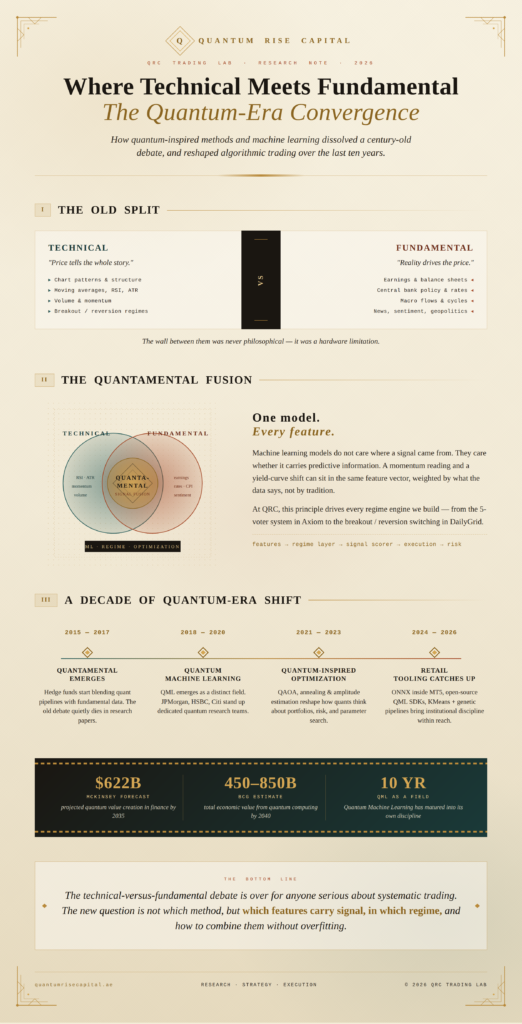
For most of trading history, the technical and fundamental camps sat on opposite sides of the room. Technical traders watched charts and believed price already told the whole story. Fundamental traders read earnings reports, central bank statements, and balance sheets, and believed price was just a delayed reflection of reality. Both sides were partly right, and both were missing something. Over the last ten years, that wall has come down in a way most retail traders still haven’t fully noticed.
The shift didn’t happen because someone wrote a better book on chart patterns or invented a new oscillator. It happened because the tools changed. Quantitative methods, machine learning, and the early wave of quantum-inspired computation pushed trading into a different shape entirely. At QRC Trading Lab, this is the world we build inside every day, so it’s worth pulling apart what actually changed and why it matters for anyone serious about algorithmic trading in 2026.
The Old Split Was Never Real
Technical analysis was always about pattern recognition. Fundamental analysis was always about cause and effect. The reason traders fought about which one mattered more is that both were too computationally heavy for a human to run at the same time, at scale, across hundreds of instruments. So people picked a side and defended it.
A chartist could eyeball a NAS100 setup in seconds. A fundamental analyst could read a Fed statement and form a view by lunch. Asking either of them to do both, simultaneously, across every liquid market, every fifteen minutes, was simply not on the table. The split between technical and fundamental analysis wasn’t philosophical. It was a hardware limitation dressed up as a worldview.
Algorithms changed that. Once you can encode rules, run them on a machine, and test them against decades of data, the question stops being which method is better and starts being which combination of inputs actually predicts the next move. That’s the question quantitative trading was built to answer, and it’s the question that quietly dissolved the old debate.
The Rise of Quantamental
Somewhere around 2016 to 2018, the term quantamental started showing up in serious research papers and hedge fund reports. It’s an ugly word, but it describes something real. A quantamental strategy uses quantitative tools, which usually means statistical models, machine learning, and systematic backtesting, but it feeds those tools with both technical signals and fundamental data. Earnings surprises sit next to RSI readings. Central bank tone gets scored and treated as a feature the same way ATR or moving average slope would be.
What makes this work is not that one type of data is better than the other. It’s that machine learning models, especially the kind we use for regime detection and signal scoring, don’t care where a feature came from. They care whether it carries predictive information. If a momentum reading and a yield curve shift both move the probability of a clean breakout, the model uses both. If one drops out under certain market regimes, the model learns to ignore it.
This is exactly the philosophy behind our internal work on regime engines. The QRC DailyGrid EA and the Axiom Adaptive Regime EA both rely on the idea that the market is not one thing. It moves through breakout phases, mean-reverting phases, compressed-range phases, and shock phases, and the right strategy for each one is different. A pure technical model that ignores macro context will trade a CPI release the same way it trades a sleepy Tuesday. A pure fundamental model will miss the actual entry timing entirely. A regime-aware quantamental system handles both.
Where Quantum Enters the Picture
Now to the part that gets oversold in marketing copy and underexplained in serious work. Quantum computing has not yet replaced classical infrastructure in any production trading desk. What it has done, over the last decade, is reshape how serious quants think about computation, optimization, and probability.
A few things are real and worth naming. First, finance is widely expected to be one of the first industries to gain meaningful value from quantum hardware, with major banks like JPMorgan Chase and HSBC running dedicated quantum research teams and groups like Citi, Mizuho, and Truist also exploring enhanced trading strategies, risk modeling, and portfolio optimization. Second, the McKinsey and BCG estimates of long-term value creation in finance from quantum methods run into the hundreds of billions of dollars, with most of that concentrated in optimization and risk modeling rather than trade execution. Third, quantum machine learning has emerged as a distinct subfield over the last decade, and it’s already influencing how classical models are designed, even when the model itself never touches a quantum processor.
The practical effect for traders has been indirect but significant. Quantum-inspired optimization, like quantum annealing and the Quantum Approximate Optimization Algorithm, gave researchers new ways to think about portfolio construction and parameter search. Even when those algorithms run on classical hardware, they shape how people approach problems. The KMeans clustering pipeline we use at QRC for optimization, where we run genetic searches across thousands of parameter combinations and then cluster the survivors by composite quality score, has roots in this broader shift toward treating optimization as a search through high-dimensional probability space rather than a hill-climb on a single curve.
The other indirect effect is on derivative pricing and risk. Monte Carlo methods, which sit at the core of most modern risk systems, get a theoretical speedup from quantum amplitude estimation. Even before that speedup is production-ready, the awareness that it exists has pushed risk teams to rebuild their classical Monte Carlo infrastructure in ways that will plug into quantum hardware when it arrives. That’s the thing about quantum thinking. The hardware is still maturing, but the mental model has already changed the field.
What This Means for the Working Algorithmic Trader
For someone running a serious systematic strategy in 2026, three things follow from all of this.
The first is that the technical versus fundamental debate is over for anyone who wants to compete with institutional flow. The question is no longer which type of analysis to use. The question is which features carry signal, in which regime, and how you combine them without overfitting. A modern Expert Advisor that ignores macro context is leaving information on the table. One that tries to trade purely on news events without technical filtering is exposed to noise that a simple ATR guard would have caught.
The second is that optimization has gotten harder, not easier. More features means more dimensions, and more dimensions means more ways to fool yourself. The discipline that matters most is no longer finding a clever indicator. It’s separating real edge from curve-fit noise. This is why our work leans so heavily on KMeans clustering across genetic optimization runs, on out-of-sample validation, on Phase 2 and Phase 3 verification, and on rejecting symbols that look good in one phase but fail in another. The math behind this discipline borrows directly from the same statistical thinking that drives quantum machine learning research.
The third is that the gap between retail and institutional tooling has narrowed in some places and widened in others. ONNX runtime inside MetaTrader 5 means a retail trader can run a trained neural network on live ticks. Open-source quantum SDKs like Qiskit and PennyLane let anyone experiment with quantum machine learning on simulators. At the same time, the institutional edge in data access, latency, and capital remains substantial. The retail systematic trader who wins is the one who picks the battles where quality of model and discipline of process matter more than raw infrastructure.
The Honest Position
It would be easy to wrap this in the usual quantum-hype language and tell you that quantum computers are about to revolutionize how you trade gold on the fifteen-minute chart. That’s not true, and we don’t say things that aren’t true. What is true is that the last ten years have changed what serious trading research looks like. The combination of technical and fundamental signals, the rise of regime-aware machine learning, the slow but real influence of quantum-inspired methods on optimization and risk, and the maturing of tools like ONNX, genetic algorithms, and clustering pipelines have all moved the goalposts.
The traders and firms that adapted are not necessarily smarter than the ones who didn’t. They just stopped arguing about which side of the chart-versus-balance-sheet wall they belonged on, and started treating every data source as a candidate feature in a properly tested system.
That’s the shift. It’s not glamorous, it doesn’t fit on a magazine cover, and it doesn’t make for a good Twitter thread. But it’s the actual story of how trading changed over the last decade, and it’s the foundation everything we build at QRC sits on.
