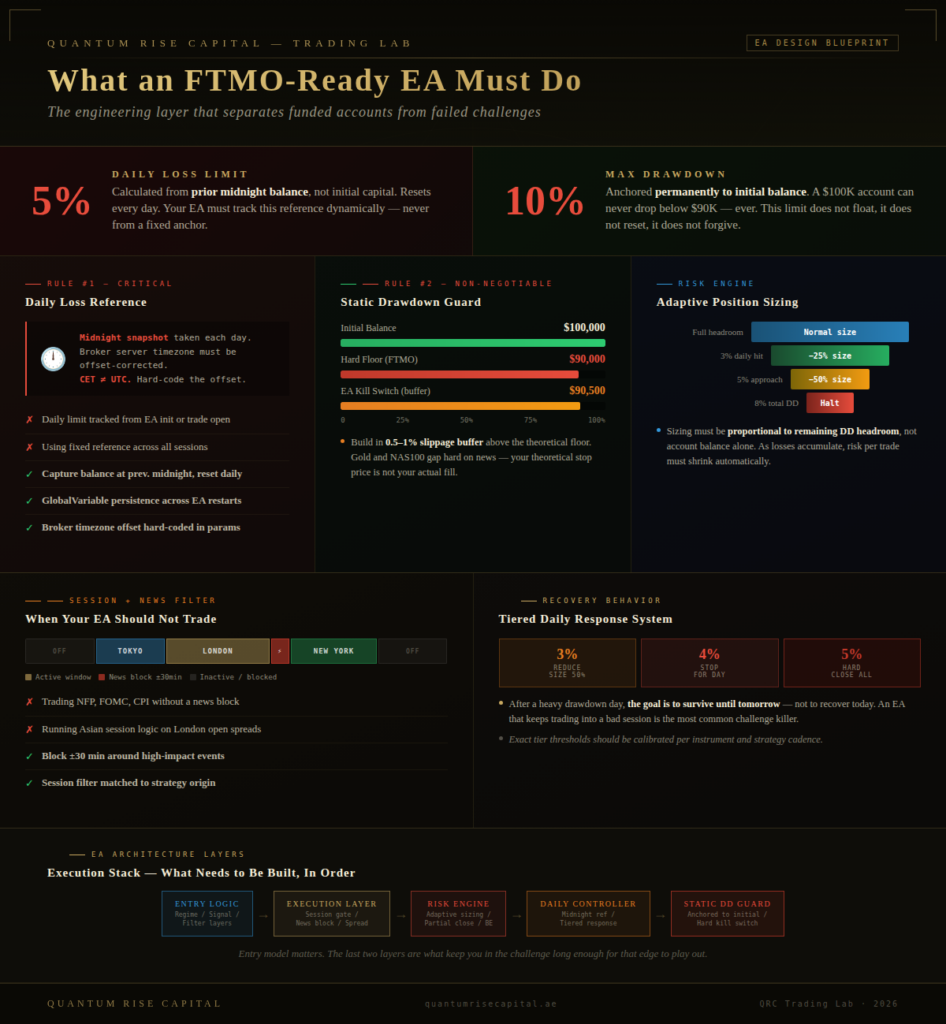
A lot of traders approach FTMO Challenge challenges the wrong way. They take a strategy they’ve been running on a demo account, throw it at a challenge account, and wonder why it blows up in week two. The problem usually isn’t the entry logic. It’s everything around it.
FTMO Challenge has two hard rules that don’t care about your win rate: a 5% daily loss limit and a 10% maximum drawdown from your initial balance. That’s it. Those two numbers will end your FTMO Challenge faster than a bad trade signal if your EA isn’t built to respect them at a mechanical level.
So what does that actually mean in code?
The daily loss calculation is not what most people think
Understanding the FTMO Challenge Requirements
Key Strategies for Passing the FTMO Challenge
Understanding the FTMO Challenge requirements is crucial for success.
FTMO Challenge calculates your daily loss from your balance at the previous day’s midnight, not from your starting balance. This matters more than it sounds. If your EA is tracking the daily limit from a fixed reference point, it’s calculating the wrong number. The result is that you might think you have 3% left before the limit when you actually have 1.8%. Or the reverse, which is less dangerous but still wrong.
Your EA needs to capture the balance at midnight each day and reset the reference from there. Not on trade open. Not on EA init. At midnight. If you’re running on a broker with a non-UTC server time, you need to account for the offset explicitly. A CET server doesn’t roll over at the same moment as a UTC calculation, and that gap has caught people out.
Static drawdown is anchored to initial capital, not current balance
The 10% max drawdown is calculated from the account starting balance. So on a $100,000 challenge, you can never let equity drop below $90,000. Ever. Your EA needs a global stop that watches equity in real time and closes everything if you approach that level. Not a soft warning. A hard close with enough buffer to account for slippage.
The buffer matters. If you set your hard stop at exactly $90,000 and gold gaps $200 against you, you’re out of the challenge regardless of the stop logic. Build in at least 0.5-1% of breathing room below your theoretical limit.
Position sizing needs to scale, not stay flat
A lot of retail EAs use fixed lot sizes or simple pip-based formulas. That’s fine for demo trading. For FTMO, you want sizing that’s proportional to your remaining drawdown headroom. As your equity grows, your allowed daily loss grows with it. As you take losses and headroom shrinks, position size should shrink automatically.
This isn’t about being conservative for its own sake. It’s about the math. An EA that risks 2% per trade on a full account but doesn’t reduce size after a string of losses will eventually stack those losses into a single bad day that ends the challenge.
By understanding the FTMO Challenge requirements, you can create an EA that truly excels.
News and session awareness
A simple calendar filter can help avoid FTMO Challenge pitfalls.
FTMO doesn’t require you to avoid news events, but an EA that trades through NFP or FOMC releases is taking unnecessary variance risk. One bad fill during a liquidity void can blow your daily limit before the position has a chance to breathe. A simple economic calendar filter, or even just blocking trades in the 30 minutes around high-impact events, removes a lot of that randomness.
In the context of the FTMO Challenge, recovery behavior can make or break your success.
Session filtering is worth adding too. If your strategy was built around London session dynamics, there’s no reason it should be firing trades at 2am when spreads are wide and volume is thin.
In conclusion, mastering the FTMO Challenge is about preparation and understanding your risks.
The recovery behavior is what separates passing EAs from failing ones
When your EA takes a bad day and you’re sitting at 3-4% drawdown by the time London closes, what does it do? If the answer is “keep trading normally,” you’re going to fail a lot of challenges. After a significant drawdown day, the EA should either stop trading entirely for the rest of the session or reduce size significantly. The goal is to still be in the challenge tomorrow, not to recover today.
We’ve been through this with most of the EAs in the QRC portfolio, including those designed for the FTMO Challenge.
The strategies that pass FTMO Challenge challenges consistently aren’t the ones with the best Sharpe ratios.
Some traders implement a tiered response: at 3% daily drawdown, reduce size by 50%; at 4%, stop trading for the day. Something along those lines. The exact numbers depend on your normal trade cadence, but the concept is non-negotiable.
What this looks like in practice
We’ve been through this with most of the EAs in the QRC portfolio. Nexus running on XAUUSD, Axiom on NAS100 — both went through multiple iterations specifically to get these FTMO mechanics right. Not because the underlying strategies were wrong, but because the risk layer around them wasn’t built for the challenge ruleset initially.
The strategies that pass FTMO challenges consistently aren’t the ones with the best Sharpe ratios. They’re the ones that treat the drawdown limits as real constraints and build the entire execution and risk logic around them. The entry model matters. The exit model matters more. But the daily loss controller and the max drawdown guard are what keep you in the game long enough for those edges to play out.
Build those FTMO Challenge components first.
