Most people who start trading obsess over win rate. They’ll tell you their system wins 80% of the time like it settles the argument. It doesn’t. A system can win 80% of its trades and still drain your account, and another can lose 60% of the time and compound steadily for years. The difference lives in a handful of ratios that most beginners skip past.
At QRC, every EA we build gets judged on these numbers before it ever touches a live FTMO account. Here’s what each one means and why it matters, with a single running example so you can see how they connect.
The example: a strategy that takes 100 trades. It wins 40 of them and loses 60. Each win averages $300, each loss averages $100. We’ll carry this through.

Understanding the Key Numbers
Risk-Reward Ratio (RRR)
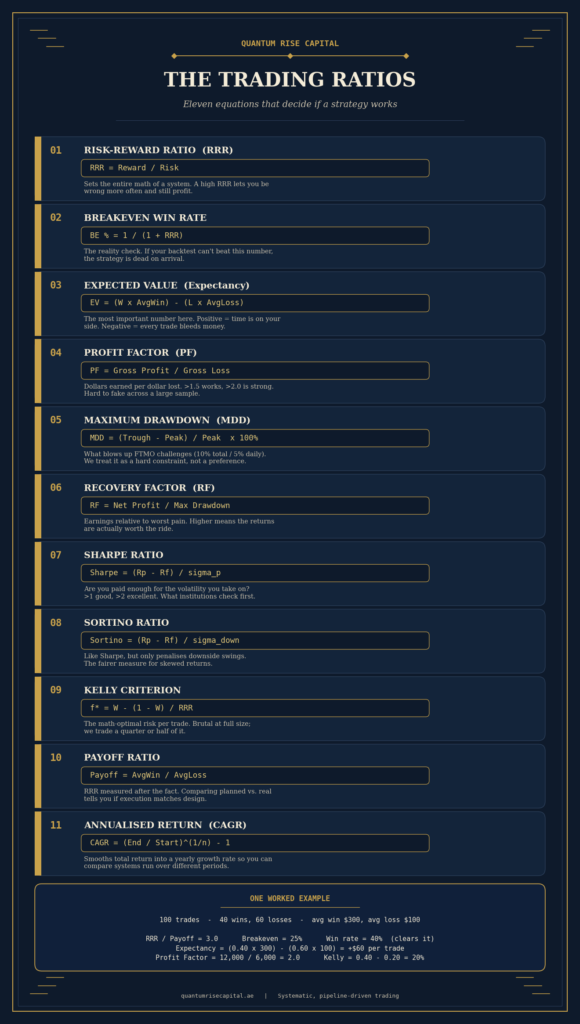
RRR = Reward (target distance) / Risk (stop distance)This is reward divided by risk on a single trade. If your target sits $200 away and your stop sits $100 away, your RRR is 2.0. You’re risking one dollar to make two.
In our example, average win is $300 and average loss is $100, so the realized RRR is 3.0.
Why it matters: RRR sets the entire math of your system. A high RRR means you can be wrong more often than you’re right and still make money. Most traders set it too low because small targets feel safer, then wonder why a 65% win rate isn’t paying the bills.
Breakeven Win Rate
Breakeven % = 1 / (1 + RRR)The minimum win rate you need just to not lose money at a given RRR.
At an RRR of 3.0, breakeven win rate is 1 / 4 = 25%. So our example strategy, winning 40%, clears breakeven comfortably.
Why it matters: this is the reality check. Before you fall in love with a setup, calculate the win rate it needs. If the breakeven number is higher than what your backtest produces, the strategy is dead on arrival and no amount of tweaking entries will save it.
Expected Value (Expectancy)
EV = (Win rate x Avg Win) - (Loss rate x Avg Loss)The average profit or loss per trade over the long run.
For us: (0.40 × $300) − (0.60 × $100) = $120 − $60 = $60 per trade.
Why it matters: this is the single most important number on the list. A positive expectancy means time is on your side. Negative means every trade you take is, on average, handing money away. If you only check one metric, check this one.
Profit Factor (PF)
PF = Gross Profit / Gross LossAdd up everything you made, divide by everything you lost.
Gross profit: 40 wins × $300 = $12,000. Gross loss: 60 losses × $100 = $6,000. PF = 2.0.
Why it matters: PF tells you how much you earn for every dollar you lose. Below 1.0 you’re losing money. Around 1.5 is a working system. Above 2.0 is strong. We weight PF heavily in our optimization scoring because it’s hard to fake across a large sample.
Maximum Drawdown
MDD = (Trough Value - Peak Value) / Peak Value x 100%The largest drop from an equity peak to the following trough, measured as a percentage. If your account hits $11,000 then falls to $9,900 before recovering, that’s a 10% drawdown from the peak.
Why it matters: this is what blows up FTMO challenges. The rules cap you at 10% total and 5% daily. A strategy with great expectancy and an ugly drawdown will still fail the challenge, so we treat drawdown as a hard constraint, not a preference.
Recovery Factor
RF = Net Profit / Maximum DrawdownIt measures how much the system earns relative to its worst pain.
If our example nets $6,000 and the worst drawdown was $1,500, recovery factor is 4.0.
Why it matters: two strategies can post the same profit, but the one that did it without a stomach-churning drawdown is the one you can actually trade with size. Higher recovery factor means the returns are worth the ride.
Sharpe Ratio
Sharpe = (Portfolio Return - Risk-free Rate) / Std Dev of ReturnsReturn above the risk-free rate, divided by the standard deviation of returns. It rewards smooth, consistent gains and punishes wild swings.
Why it matters: Sharpe answers a question raw profit can’t: are you being paid enough for the volatility you’re taking on? Above 1.0 is good, above 2.0 is excellent. It’s the metric institutional money looks at first, which is why it sits in our composite score.
Sortino Ratio
Sortino = (Portfolio Return - Risk-free Rate) / Downside DeviationSame idea as Sharpe, but it only counts downside volatility in the denominator. Big upside swings don’t get penalized.
Why it matters: Sharpe punishes a strategy for having a few enormous winning months, which is backwards. Sortino fixes that by caring only about the volatility that actually hurts you. For systems with skewed returns, it’s the fairer measure.
Kelly Criterion
f* = Win rate - (Loss rate / RRR)The fraction of your account math says you should risk per trade to grow capital fastest.
For us: 0.40 − (0.60 / 3.0) = 0.40 − 0.20 = 0.20, or 20%.
Why it matters: full Kelly is brutally aggressive and almost nobody trades it straight. A 20% risk per trade would give you heart palpitations. We use a fraction of it, usually a quarter or a half, to capture most of the growth with a fraction of the volatility. Knowing the number tells you the ceiling, then you back well off it.
Payoff Ratio
Payoff = Avg Winning Trade / Avg Losing TradeIt’s RRR measured after the fact, from trades that actually closed, rather than from the targets you planned.
In our example that’s $300 / $100 = 3.0.
Why it matters: planned RRR and realized payoff often diverge. Slippage, partial fills, and trades that get stopped halfway all pull the real number around. Comparing the two tells you whether your execution matches your design.
Annualised Return (CAGR)
CAGR = (Ending Value / Starting Value)^(1/n) - 1where n is the number of years. It smooths total return into a single yearly growth rate.
Why it matters: a 60% gain means nothing until you know whether it took six months or six years. CAGR puts every system on the same footing so you can compare a fast aggressive strategy against a slow steady one honestly.
How they fit together
No single ratio decides anything. Expectancy tells you the system makes money. Profit factor confirms the edge holds across many trades. Drawdown and recovery factor tell you whether you can survive the journey. Sharpe and Sortino tell you whether the returns justify the risk. Kelly tells you how hard to push.
When we run an EA through optimization, we score it on a weighted blend of profit factor, recovery factor, Sharpe, and drawdown, then validate the survivors with walk-forward testing. A strategy has to earn its place across all of them. Pretty backtests built on one flattering number don’t make the cut.
If you’re building or buying a trading system, run it through this list. The strategies worth trading hold up under every one.
