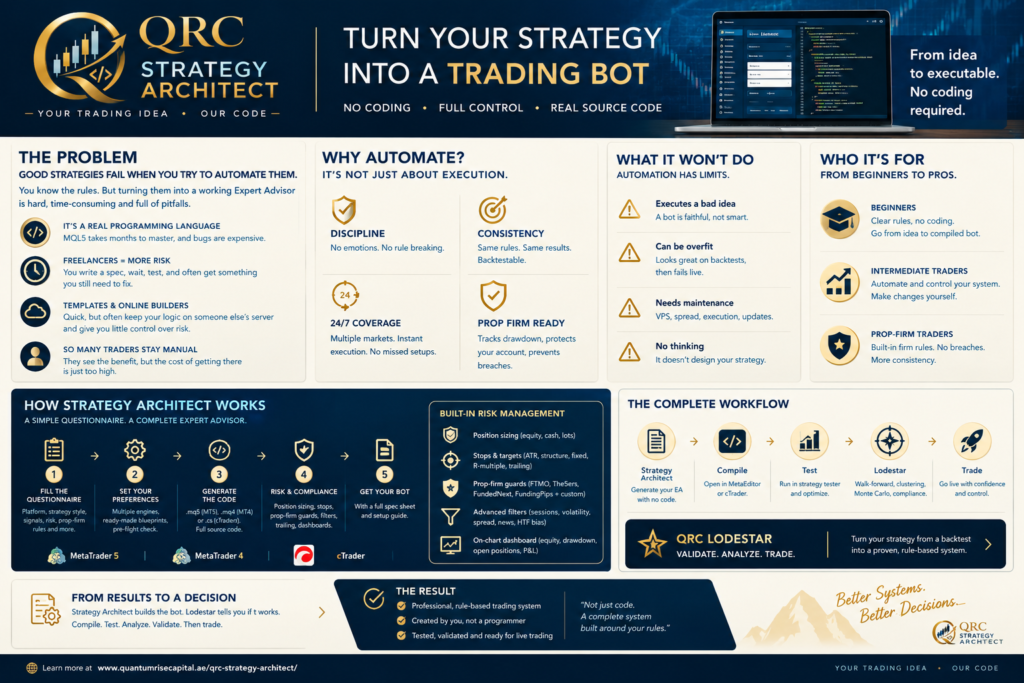
Automated trading systems do one thing better than any trader alive: they follow the rules. Every time. At 3am, after four losses in a row, on the day you’d rather not look at the chart. That sounds minor until you count how many of your own losing trades came from breaking a rule you already knew.
Ask a discretionary trader why last month went badly and the answer is rarely the strategy. It’s the stop they moved, the trade they took out of boredom, the size they doubled to win it back. The plan was fine. The person running it had a bad week.
Why automated trading systems beat good intentions
Discipline is the obvious benefit. Code doesn’t get bored, scared or greedy. A daily loss limit written into a bot is checked before every order goes out. A daily loss limit written on a sticky note is a suggestion.
Consistency is the less obvious one, and it matters more. When the same rules run the same way every time, the results start to mean something. You can backtest them, measure them and improve them. You can’t backtest a gut feeling, because your gut on Tuesday isn’t the same as your gut on Friday. That’s why serious traders move to automated trading systems: they turn trading into something you can test.
Then there’s coverage. A bot can watch EURUSD through London, gold through New York and the indices in between without getting tired, and it reacts in milliseconds instead of whenever you happen to look. Running the same logic on a second symbol or a second account costs nothing extra.
For prop-firm traders, automated trading systems solve a very specific problem. Plenty of challenges are lost to a rule breach rather than a bad strategy: one oversized trade on a red day and the daily loss limit is gone. A bot that tracks its own drawdown against the firm’s rules and stops before the line is often worth more than a better entry signal.
What automated trading systems won’t do for you
A bot executes a bad idea exactly as faithfully as a good one. If the logic has no edge, automation just loses money faster and more consistently than you would by hand.
Overfitting is the second trap, and automated trading systems make it easy to fall into. You can tune a bot until its backtest looks perfect, at which point it has learned the past and nothing else. And there’s plumbing to look after: a VPS, differences in spread and execution between brokers, the occasional platform update.
Automated trading systems take emotion out of execution. They don’t take the thinking out of strategy design, and anyone who tells you otherwise is selling something.
Why most traders never build automated trading systems
The gap between “I have a strategy” and “I have a working Expert Advisor” is code. MQL5 is a real programming language. Learning it well enough to write a bot that handles position sizing, broker volume steps, server time offsets and news events takes months, and the bugs are expensive because you usually find them with live money.
The usual shortcuts have their own problems. Hiring a freelancer means writing a spec, waiting, testing, finding out what was misunderstood and paying for revisions. Risk handling is often an afterthought, and you may end up with a compiled file you can’t read or change. Generic template bots and online builders are quicker, but many keep your logic on someone else’s server and give you little say over how risk is managed.
So a lot of capable traders stay manual. They can see the benefit. The cost of getting there is just too high.
How QRC Strategy Architect builds automated trading systems without code
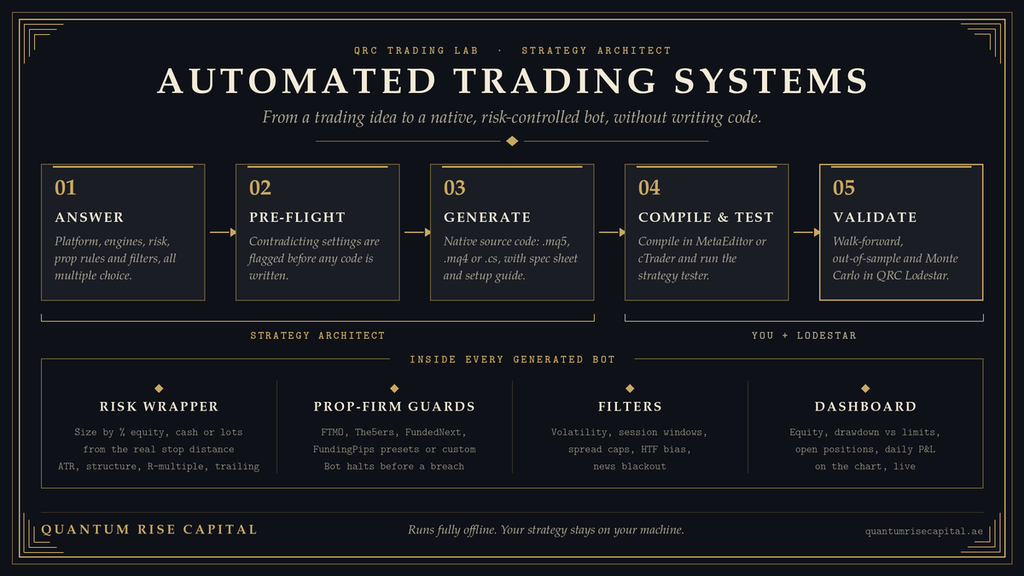
We built QRC Strategy Architect for that gap. It’s a desktop app that asks you a set of multiple-choice questions about how you trade and then writes a complete Expert Advisor in the platform’s own language: .mq5 for MetaTrader 5, .mq4 for MetaTrader 4, or .cs for cTrader. You get real source code you can open, compile and keep.
The questionnaire walks through your platform, strategy style, signal engines, risk settings, prop-firm rules and filters. You can run one engine or combine several, MACD with CCI for example, so a trade only fires when all of them agree. If you’d rather not start from a blank page, there are ready-made blueprints to adapt. Before anything is generated, a pre-flight check flags settings that contradict each other.
Most of the generated code goes into risk control. In automated trading systems built by beginners, that’s usually the missing piece, and it’s the part that decides whether an account survives.
Position sizing works by percent of equity, fixed cash or fixed lots, normalised to your broker’s volume steps and calculated from the actual stop distance. Stops and targets can be ATR-based, structure-based, fixed, R-multiple or trailing.
Prop-firm guards ship with presets for FTMO, The5ers, FundedNext and FundingPips, covering static or trailing drawdown on equity or closed balance, and you can enter custom limits for any other firm. The bot halts itself before a breach.
Filters handle volatility, session windows with broker GMT correction, weekdays and rollover, spread caps, higher-timeframe bias and a news blackout. Optional pyramiding, grid or DCA logic is capped and bounded, alongside break-even, trailing stops and partial take-profits.
Every build also includes an on-chart dashboard showing equity, drawdown against your limits, open positions and daily P&L, plus a plain-language spec sheet and setup guide that explain exactly what the bot does. The whole tool runs offline, so your strategy never leaves your machine.
On a professional trading desk, the entry signal is rarely the impressive part. What keeps the desk in business is risk that’s enforced in code: every position sized off its stop, hard loss limits, trading paused when conditions are wrong. That’s the structure Strategy Architect wraps around your idea, and it’s what makes the difference between scripts that place trades and automated trading systems you can trust with an account.
From generated code to a validated bot
We’re upfront about the limit here. Strategy Architect writes correct, rule-compliant code that does what you asked it to do. Whether the strategy makes money depends on the strategy.
So the workflow doesn’t stop at generation. Compile the file in MetaEditor or cTrader, run it in the strategy tester on your symbol and timeframe, then take the optimization results into QRC Lodestar. Lodestar runs walk-forward and out-of-sample analysis, parameter clustering and a prop-firm Monte Carlo, so you find out whether the edge holds on data it has never seen before any money is at risk. If walk-forward testing is new to you, our guide to progressive backtesting explains why it matters. Only after that do you go to demo or minimum size.
Build it, prove it, then trade it. In that order.
Who it’s for
Strategy Architect is for traders who want automated trading systems without becoming programmers. If you’re a beginner with a clear set of rules and no programming background, the questionnaire gets you from idea to compiled bot without writing a line. If you’re an intermediate trader who has been running a system by hand, it lets you automate it and change it yourself instead of paying a developer for every tweak. And if you trade prop-firm challenges, it puts the firm’s rules inside the bot, where they can’t be forgotten on a bad day.
Getting started with automated trading systems
The full feature list, the prop-firm presets and the workflow are on the QRC Strategy Architect page: https://www.quantumrisecapital.ae/qrc-strategy-architect/
Start with a strategy you already trade by hand. You know how it should behave, which makes it easy to check that the bot behaves the same way. Then test it properly before you trust it with money.
Trading leveraged products carries a high risk of loss. Automated trading systems do not guarantee results, and any bot should be tested and validated before it trades live.
External Links:
- “MQL5 is a real programming language.” Link “MQL5” to the official MQL5 Reference.
- “…or .cs for cTrader.” Link “cTrader” to the cTrader Algo documentation.
- “…run it in the strategy tester on your symbol and timeframe.” Link to the MetaTrader 5 Strategy Testing help page.
- “…one oversized trade on a red day and the daily loss limit is gone.” Link to FTMO’s Trading Objectives, where the firm defines its loss limits.
- “Overfitting is the second trap…” Link to The Probability of Backtest Overfitting (Bailey, Borwein, López de Prado, Zhu).
- “Trading leveraged products carries a high risk of loss.” Link to ESMA’s announcement restricting CFDs to protect retail investors.
