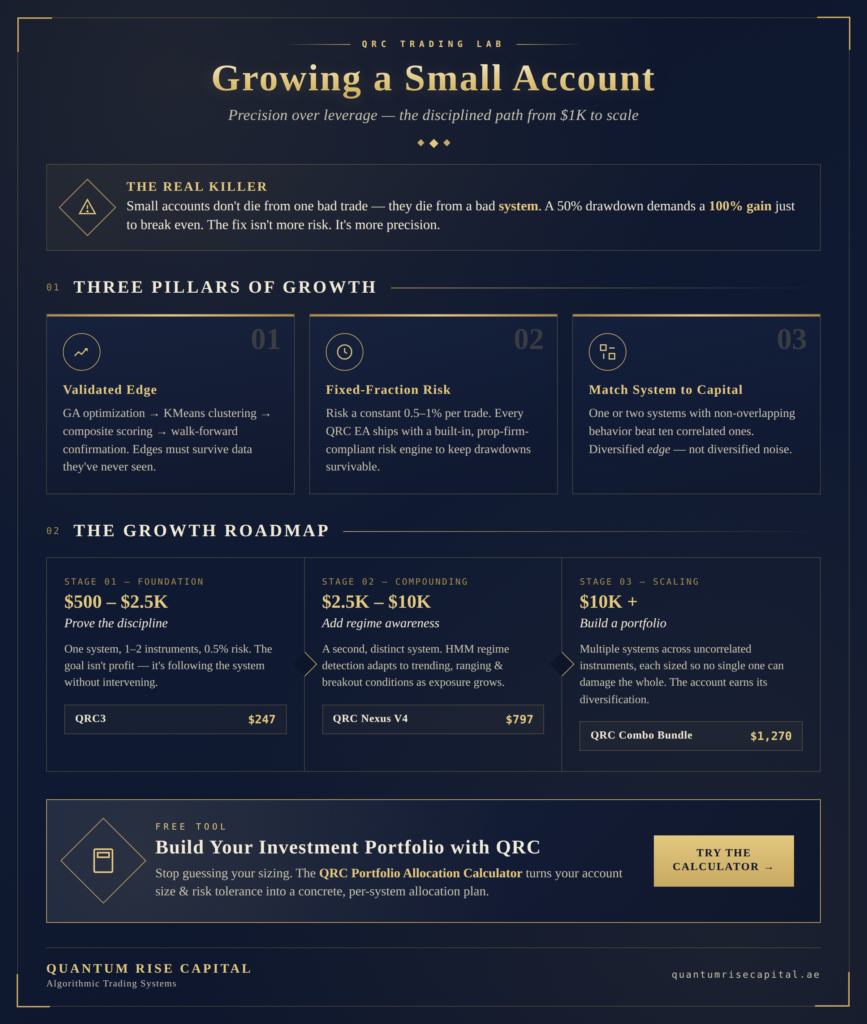
Most small accounts don’t die from a bad trade. They die from a bad system — over-leveraged entries, no regime awareness, and position sizing pulled out of thin air. The irony is that growing a small account doesn’t require more risk than growing a large one. It requires more precision. When your margin for error is thin, your edge has to be real, your risk has to be mechanical, and your capital has to be deployed with intent.
This is how we think about it at Quantum Rise Capital.
Why Small Accounts Fail
A trader funds a $1,000 account and immediately wants it to behave like $100,000. So they oversize. A single 5% loser becomes a 5% drawdown, three in a row becomes a 15% hole, and the math of recovery turns brutal — a 50% drawdown requires a 100% gain just to break even. The account isn’t beaten by the market. It’s beaten by compounding losses faster than it can compound gains.
The fix isn’t a better indicator. It’s structure: a tested edge, fixed-fraction risk, and an allocation that respects how little room you actually have.
The Three Pillars of Small-Account Growth
Growing a Small Account: Discipline is Key
1. Trade a validated edge, not a hunch
Every QRC Expert Advisor is built and validated through the same pipeline: genetic optimization, KMeans clustering to isolate robust parameter regions rather than curve-fit outliers, composite scoring across profit factor, recovery factor, Sharpe, and drawdown, then walk-forward confirmation on out-of-sample data. A small account has no budget for systems that only looked good in a backtest. The edge has to survive data it has never seen.
2. Risk a fixed fraction, every time
The single highest-leverage decision for a small account is the percentage risked per trade — not the entry. Risking a fixed 0.5%–1% of equity per position keeps drawdowns survivable and lets compounding do its work over months, not minutes. Every QRC EA ships with a built-in risk engine designed around exactly this discipline, including prop-firm-compliant configurations for traders running funded challenges.
3. Match the system to your capital
You don’t need ten EAs on a $1,000 account. You need one or two with non-overlapping behavior. Pairing a session-based system with a regime-detection system gives you exposure to different market conditions without doubling your risk into the same trade. The goal is diversified edge, not diversified noise.
A Practical Small-Account Roadmap
Stage 1 — Foundation ($500–$2,500): One system, one or two instruments, 0.5% risk per trade. The objective here is not profit — it’s proving you can follow the system without intervening. A great fit at this stage is QRC3, a focused, accessible entry into the QRC methodology at $247.
Stage 2 — Compounding ($2,500–$10,000): Add a second, behaviorally distinct system. This is where regime awareness earns its place. QRC Nexus V4 ($797) uses HMM-based regime detection through a six-layer pipeline, so the system adapts to whether the market is trending, ranging, or breaking out — exactly the adaptability a growing account needs as it takes on more exposure.
Stage 3 — Scaling & Diversification ($10,000+): Now you build a portfolio. Multiple systems across uncorrelated instruments, each sized so that no single system can meaningfully damage the whole. The QRC Combo bundle ($1,270) is designed for this stage — a coordinated set of systems rather than a pile of standalone tools.
Notice the pattern: risk discipline stays constant while complexity grows only as capital grows. The account earns its diversification.
Build Your Investment Portfolio with QRC
Knowing you should allocate carefully and knowing how much to put where are two different problems. That’s why we built the QRC Portfolio Allocation Calculator — a free tool on our site that takes your account size and risk tolerance and turns it into a concrete, per-system allocation plan.
Instead of guessing, you get a structured breakdown: how much capital each EA should run, what fixed-fraction risk that translates to, and how the pieces fit together as a single portfolio rather than a set of disconnected bets. For a small account, this is the difference between hoping your sizing is right and knowing it is.
Build your investment portfolio with QRC → Try the Portfolio Allocation Calculator
The Bottom Line
Small accounts aren’t grown by swinging harder. They’re grown by removing the leaks — emotional sizing, untested edges, and over-diversification into correlated risk — and replacing them with a validated system, mechanical risk, and a deliberate allocation. Start with one QRC system, hold your risk constant, let the calculator structure your capital, and add complexity only as the account proves it can carry it.
The market rewards patience that’s backed by structure. QRC is built to give you both.
Quantum Rise Capital develops and validates algorithmic trading systems through a standardized optimization and walk-forward pipeline. Past performance does not guarantee future results. Trading carries risk, including the loss of capital. Nothing in this article constitutes financial advice — allocate according to your own risk tolerance and circumstances.
