By QRC Research Desk · Prop Firm Series · 2026
The FTMO Challenge has become one of the most practical ways for algorithmic traders to trade large simulated capital without risking much of their own money. It’s arguably the most rigorous evaluation in the industry, and it tests two things at once: performance and discipline. That combination is where a well-built Expert Advisor has a structural advantage over a discretionary trader.
This guide covers how to configure, test and run an EA for the FTMO Challenge, drawing on our experience building and running EAs on NAS100, US500, US30 and XAUUSD. Rule references reflect FTMO’s published trading objectives at the time of writing. FTMO updates its terms, so check the current version before you buy a challenge.
Why an EA has an edge in the FTMO Challenge
The hardest part of an FTMO Challenge usually isn’t finding profitable setups. It’s following the rules without deviation for weeks. Human traders overtrade when bored, revenge-trade after losses and hesitate at the entries that matter. An EA does none of that.
FTMO’s rules also map directly onto the risk controls any well-built EA should already have: a daily loss limit, a hard floor on total loss and consistent position sizing. If those are hardcoded into your EA, you’re ahead of most people attempting the challenge.
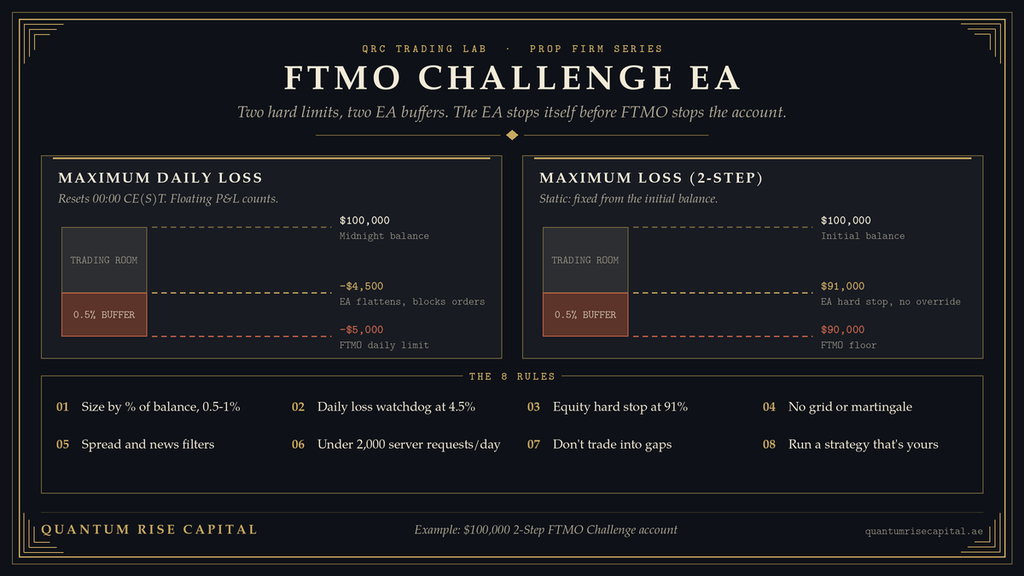
On the 2-Step FTMO Challenge, the 10% Maximum Loss is static. It’s calculated from your initial balance, not your equity peak, so a $100,000 account has a fixed floor at $90,000. That’s more forgiving than a trailing drawdown and gives an EA room to recover from a normal losing streak. The newer 1-Step FTMO Challenge works differently: its 10% Maximum Loss trails your highest end-of-day balance and the daily limit is 3%, so an EA built for one model needs its limits reset for the other.
The FTMO Challenge rules your EA must respect
These are the 2-Step FTMO Challenge objectives as FTMO publishes them:
| Rule | FTMO Challenge (Phase 1) | Verification (Phase 2) |
|---|---|---|
| Profit target | 10% | 5% |
| Maximum Daily Loss | 5% of initial balance | 5% of initial balance |
| Maximum Loss | 10%, static | 10%, static |
| Minimum trading days | 4 | 4 |
| Trading period | Unlimited | Unlimited |
Once you pass both phases and trade an FTMO Account, the reward is up to 90% of simulated profits.
Two details matter when you code the limits. The daily limit resets at midnight CE(S)T, and each day it equals the previous midnight balance minus 5% of the initial balance. FTMO also measures it against equity, which includes floating profit and loss, so an open trade can breach the limit before it ever closes.
How to configure your EA for the FTMO Challenge: 8 rules
1. Size every trade as a percentage of balance
Never use fixed lot sizes on a prop challenge. Risk a percentage of balance per trade, ideally 0.5% to 1.0%. That way no single trade can hit the daily loss limit, and a losing streak eats into your drawdown slowly.
On a $100K FTMO account, cap the total open risk at any moment at 2% to 3% of balance. That leaves room for correlated losses without getting near the 5% daily limit.
2. Build a daily loss watchdog with a buffer
Your EA needs a daily P&L monitor. It should snapshot the balance at midnight CE(S)T (watch your broker’s server-time offset), track equity including floating losses, and flatten the account once the day’s loss from that midnight balance reaches about 4.5% of the initial balance. Flattening means closing every position and blocking new orders. The 0.5% buffer covers slippage on the closing orders. Of everything in this list, this one feature prevents the most common way EA accounts fail the FTMO Challenge.
3. Add a hard stop above the maximum loss
Add a global equity watchdog: if equity falls to 91% of the initial challenge balance, the EA halts all trading and alerts you. It’s your last line of defence before the account is breached, and it shouldn’t be possible to override it during live trading. On the 1-Step FTMO Challenge, base this stop on the trailing limit instead of the starting balance.
4. Keep grid and martingale logic out of it
FTMO’s list of forbidden trading practices doesn’t name grid or martingale. It does rule out overleveraging, overexposure and one-sided bets, and it prohibits position sizes or repeated activity that raise your risk per trade idea. Adding to a losing position does exactly that, so most grid and martingale logic puts the account at risk, and it’s a poor fit for a 5% daily limit anyway. If you run a grid strategy like QRC DailyGrid, keep it for personal capital. For the FTMO Challenge, use a regime-adaptive or breakout EA with single-direction entries and defined stop losses.
5. Filter spreads and news spikes
FTMO expects your trading to be replicable on a live account, and spreads on its servers can differ from your demo broker. Give the EA a maximum spread filter so it doesn’t enter during spikes. Around NFP, FOMC or CPI releases, spreads can widen 5 to 10 times. If your EA buys NAS100 with a 30-point spread, the trade starts underwater before the market moves.
News trading is allowed during the challenge and verification. On a Standard FTMO Account, FTMO blocks order execution for 2 minutes before and after selected releases, stop losses and take profits included. Build the news filter now, not after you’re funded.
6. Keep the EA’s server activity low
FTMO lists bot hyperactivity as a forbidden practice: an EA-driven account that sends more than 2,000 server requests a day can be flagged. Scalpers that modify stops on every tick are the usual offenders. Move stops only on a new bar or past a minimum distance, and count the requests in your journal during testing.
7. Don’t trade into gaps
Holding positions overnight and over the weekend is allowed during the evaluation. Opening trades just before the market closes or right before major scheduled events to catch the gap is not, because FTMO lists gap trading among its forbidden practices. Weekend gaps are also the easiest way to lose the daily limit at Monday’s open. If you plan to trade a Standard FTMO Account after passing, the EA will have to close everything before breaks longer than two hours, so build that switch in from the start. Swing accounts don’t have this restriction.
8. Run a strategy that’s yours
FTMO allows EAs, but it warns that traders using a third-party EA may be running exactly the same strategy as many others, and that this can lead to the FTMO Account being refused under its maximum capital allocation rule. An off-the-shelf bot that thousands of people bought carries that risk. A strategy built for you, with your own parameters, doesn’t.
Common FTMO Challenge EA failures to avoid
Most failed EA attempts come down to the same handful of mistakes:
- Running the EA without a verified daily loss limit. One volatile session can end the account.
- Over-optimizing to backtest data without forward validation. Curve-fitted EAs fall apart on new data.
- Ignoring spread conditions. FTMO’s spreads can differ from your demo environment.
- Using grid or martingale logic that keeps adding risk to a losing idea.
- Holding into weekend gaps or opening trades right before the close.
- Missing the 4-day minimum. The EA must open at least one position on four separate trading days.
- Using partial closes or hedges to spread profit across days. FTMO treats that as profit smoothing when it’s done to get around its Best Day or Consistency rules.
What a winning FTMO Challenge EA setup looks like
- Regime-adaptive entry logic that trades only in the conditions it was designed for and sits out the rest.
- A hardcoded daily loss halt at 4.5% of initial balance with automatic position close.
- An equity watchdog that stops trading at 9% below the initial balance.
- Percentage-of-balance lot sizing at 0.5% to 1% per trade.
- A spread filter that pauses entries around high-impact news.
- A partial close at 1:1 reward-to-risk with the stop moved to breakeven, which locks in profit and cuts open risk.
- Walk-forward and out-of-sample validation, then at least 30 days on a demo account before the challenge.
- A VPS with a stable MT5 connection, so a sleeping laptop never misses a signal or a stop.
Recommended instruments for an FTMO Challenge EA
Not every instrument behaves well under prop firm conditions. High-liquidity, tight-spread instruments with consistent intraday volatility work best.
NAS100 (US Tech 100) has strong intraday trends and a daily range wide enough to reach targets without excessive risk. It works best on M15 or H1 with regime detection active.
US500 (S&P 500) is calmer than NAS100. Lower volatility suits conservative risk profiles in Phase 1, where protecting capital matters as much as hitting the target.
XAUUSD (gold) has high pip value and strong directional moves but wider spreads. Pair it with a tight spread filter and avoid the US session open.
Avoid exotic pairs, crypto CFDs and instruments with large overnight gaps. They add variance that can trip the daily loss limit without warning.
All QRC prop-compatible EAs are built around the FTMO model from day one. Hardcoded daily loss halts, equity watchdogs and percentage lot sizing aren’t add-ons. They’re part of the core architecture, and that’s the difference between systematic trading and gambling with leverage.
Want an FTMO Challenge system built for you?
Most traders who fail the FTMO Challenge with an EA don’t fail on strategy. They fail on a missing daily loss buffer, a server-time bug, an untested news filter, or a bought EA that thousands of other people are also running.
That’s what our services are for. If you’re serious about passing FTMO, QRC can build a tailored trading system around your strategy, your instruments and your FTMO account type, with the rules above hardcoded into the risk layer and the strategy validated out of sample before you pay for a challenge. Because it’s built for you, you’re not sharing a strategy with every other buyer of the same bot.
See what we offer on our services page: https://www.quantumrisecapital.ae/our-services/
If you’d rather build the bot yourself, QRC Strategy Architect generates native MT5, MT4 or cTrader code with prop-firm presets from a simple questionnaire, and QRC Lodestar checks it with walk-forward, Monte Carlo and prop-firm compliance tests before you go live.
Final thoughts
Passing the FTMO Challenge is less about finding alpha and more about consistent execution within defined limits. A modestly profitable EA with strict risk controls will usually outlast a high-return system with poor drawdown management.
Build your risk layer first. Test it obsessively. Then let the market do the rest.
Trading leveraged products carries a high risk of loss. FTMO trading takes place on simulated accounts, and passing a challenge doesn’t guarantee future results.
Your site blocked me from reading the services page, so check that “tailored trading system… validated out of sample before you pay for a challenge” matches what the service actually includes.
I couldn’t get keyword data from Semrush: the account doesn’t have enough API units. You can get more at https://www.semrush.com/mcp-access.
Sources:
