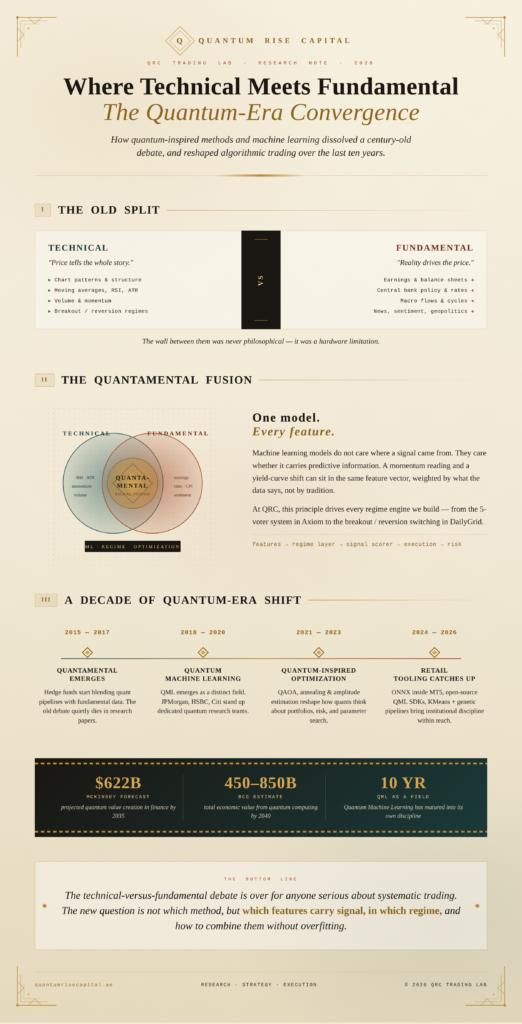
For most of trading history, technical and fundamental analysis sat on opposite sides of the room. Technical traders watched charts and believed price already told the whole story. Fundamental traders read earnings reports, central bank statements and balance sheets, and believed price was just a delayed reflection of reality. Both sides were partly right, and both were missing something. Over the last ten years that wall has come down in a way most retail traders still haven’t noticed.
The shift didn’t happen because someone wrote a better book on chart patterns or invented a new oscillator. It happened because the tools changed. Quantitative methods, machine learning and the early wave of quantum research pushed trading into a different shape. At QRC Trading Lab this is the world we build in every day, so it’s worth pulling apart what changed in technical and fundamental analysis, what’s hype, and what it means for anyone serious about algorithmic trading in 2026.
The split between technical and fundamental analysis was never real
Technical analysis was always about pattern recognition. Fundamental analysis was always about cause and effect. Traders argued over which mattered more because running both at once, at scale, across hundreds of instruments, was too much for any human. So people picked a side and defended it.
A chartist could read a NAS100 setup in seconds. A fundamental analyst could read a Fed statement and form a view by lunch. Asking either of them to do both, across every liquid market, every fifteen minutes, was never realistic. The divide between technical and fundamental analysis wasn’t philosophical. It was a hardware limit dressed up as a worldview.
Algorithms changed that. Once you can encode rules, run them on a machine and test them against decades of data, the question stops being which method is better. It becomes which combination of inputs actually predicts the next move. Quantitative trading was built to answer that question, and in answering it, the old debate quietly dissolved.
How quantamental strategies combine technical and fundamental analysis
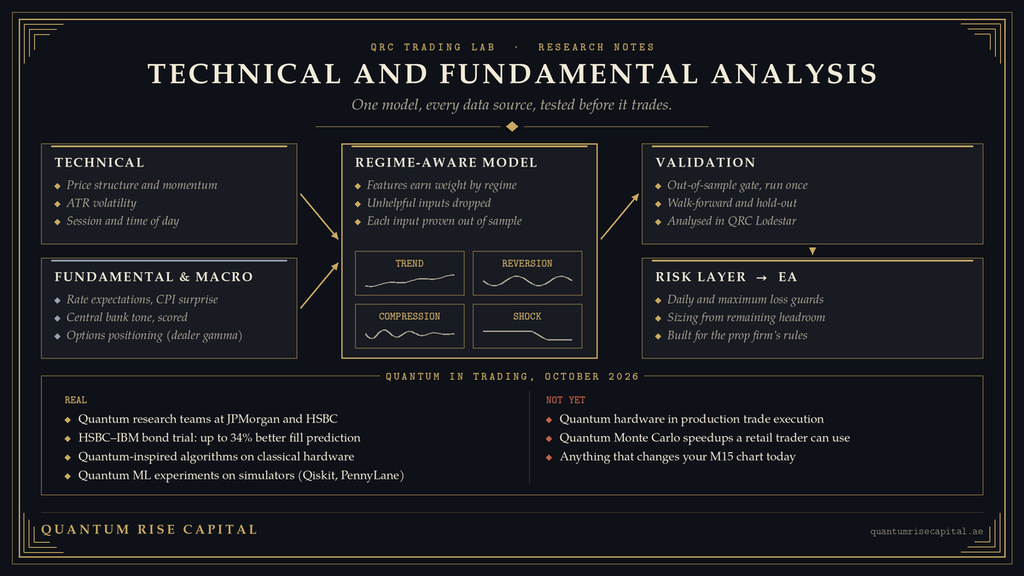
Somewhere around 2016 to 2018, the word “quantamental” started showing up in research papers and hedge fund reports. It’s an ugly word, but it describes something real. A quantamental strategy runs technical and fundamental analysis through the same quantitative tools, usually statistical models, machine learning and systematic backtesting. Earnings surprises sit next to RSI readings. Central bank tone gets scored and used as a feature, the same way ATR or moving-average slope would be.
This works because machine learning models, especially the kind used for regime detection and signal scoring, don’t care where a feature came from. They care whether it carries predictive information. If a momentum reading and a yield curve shift both change the probability of a clean breakout, the model uses both. If one stops mattering in certain regimes, the model learns to ignore it.
That’s the philosophy behind our own regime work. The market isn’t one thing. It moves through breakout phases, mean-reverting phases, compressed ranges and shocks, and each one needs a different strategy. QRC Nexus, for example, runs a regime intelligence layer, using a hidden Markov model and the Hurst exponent among its inputs, before any signal is generated. Our dealer-gamma research goes further, using options-market positioning, data that never appears on a price chart, to decide whether a trend or a mean-reversion strategy should be trading the US500 at all. A purely technical model will trade a CPI release the same way it trades a sleepy Tuesday. A purely fundamental one will miss the entry timing entirely. A regime-aware system that uses both handles each case on its own terms.
Where quantum enters technical and fundamental analysis
This is the part that gets oversold in marketing and underexplained in serious work. Quantum computing hasn’t replaced classical infrastructure on any production trading desk. What it has done over the last decade is change how serious quants think about computation, optimization and probability. It doesn’t change how you’d combine technical and fundamental analysis on an M15 chart today, but it does change how the research behind those charts gets done.
A few things are real. JPMorgan Chase and HSBC both run dedicated quantum research teams, and in September 2025 HSBC and IBM reported a trial in which a hybrid quantum-classical approach improved predictions of whether a European corporate bond trade would fill at a quoted price by up to 34% over the classical methods it was compared with. It was a trial on IBM hardware, not a production system, but HSBC called it the first-known evidence of its kind. McKinsey’s Quantum Technology Monitor 2026 puts the potential value of quantum computing in financial services at $400 billion to $600 billion by 2035, and BCG estimates $450 billion to $850 billion of value across all industries by 2040. Those are forecasts, not results, and they deserve the scepticism any forecast does. Quantum machine learning has also become a distinct research field, and it influences how classical models are designed even when no quantum processor is involved.
For traders the effect has been indirect. Research into quantum optimization, including quantum annealing and the Quantum Approximate Optimization Algorithm, also produced “quantum-inspired” methods that run on ordinary hardware, and it changed how people frame problems like portfolio construction and parameter search: as a search across a large, uneven landscape, not a climb up a single hill.
We want to be precise about our own work here. QRC’s optimization pipeline is entirely classical: genetic search, duplicate removal, rank-normalised scoring and k-means++ clustering to find broad regions of good parameters. Nothing in it runs on, or depends on, quantum hardware. It shares a way of thinking with that research, treating optimization as mapping a landscape, not finding one lucky peak, and that’s as far as the connection goes.
Risk modelling is the other indirect effect. Monte Carlo simulation sits at the core of most modern risk systems, and quantum amplitude estimation offers a theoretical quadratic speedup for it. That speedup isn’t production-ready, and for a retail trader running a few thousand simulations of a trade history, it doesn’t need to be. Classical Monte Carlo is already fast enough.
What this means for technical and fundamental analysis in algorithmic trading
For anyone running a serious systematic strategy in 2026, three lessons follow.
1. The debate is over. Feature selection isn’t.
The real question is no longer whether to use technical and fundamental analysis. It’s which features carry signal, in which regime, and how you combine them without overfitting. A modern Expert Advisor that ignores macro context leaves information on the table. One that trades purely on news without technical filtering is exposed to noise a simple ATR guard would have caught.
2. Optimization got harder, not easier
Merging technical and fundamental analysis means more features, more features means more dimensions, and more dimensions means more ways to fool yourself. The skill that matters most now isn’t finding a clever indicator. It’s separating real edge from curve-fit noise. That’s why our process is built around two optimization phases on the same in-sample window, a single out-of-sample gate, walk-forward testing and a final hold-out, and why we reject symbols that look good in one phase and fail in the next. QRC Lodestar exists to do that analysis the same way every time, from duplicate removal and input-impact scoring to out-of-sample comparison and prop-firm Monte Carlo.
3. The tooling gap narrowed in some places and widened in others
MetaTrader 5’s built-in ONNX support means a retail trader can run a trained neural network on live ticks inside an EA. Open-source quantum SDKs like Qiskit and PennyLane let anyone experiment with quantum machine learning on simulators. At the same time, institutions still hold a large edge in data access, latency and capital. The retail systematic trader who wins picks the battles where model quality and process discipline matter more than raw infrastructure.
The honest position
It would be easy to wrap this in quantum hype and tell you quantum computers are about to change how you trade gold on the fifteen-minute chart. That isn’t true, and we don’t say things that aren’t true. What is true is that the last ten years changed what serious trading research looks like. Combining technical and fundamental analysis, regime-aware machine learning, the slow influence of quantum research on optimization and risk thinking, and mature tools like ONNX, genetic algorithms and clustering pipelines have all moved the goalposts.
The traders and firms that adapted aren’t necessarily smarter than the ones that didn’t. They stopped arguing about which side of the chart-versus-balance-sheet wall they belonged on, and started treating every data source as a candidate feature in a properly tested system.
Want a system that uses both?
Combining technical and fundamental analysis in one EA is easy to describe and hard to do well. Every extra input needs a reason to exist, a regime where it matters and out-of-sample proof that it helps. QRC builds tailored trading systems around your strategy: technical entries, macro or regime filters where they earn their place, a risk layer built around your prop firm’s rules, and validation before you trade.
See what we offer on our services page: https://www.quantumrisecapital.ae/our-services/
That’s the shift. It isn’t glamorous, it doesn’t fit on a magazine cover, and it won’t make a viral thread. But it’s the real story of how trading changed over the last decade, and it’s the foundation everything we build at QRC sits on.
Trading leveraged products carries a high risk of loss. Forecasts quoted here are third-party estimates, not guarantees.
Sources:
- HSBC: quantum-enabled algorithmic trading with IBM
- McKinsey Quantum Technology Monitor 2026
- PostQuantum: McKinsey’s $400–600B finance estimate
- BCG: quantum computing to create up to $850 billion by 2040
- Finovate: HSBC, Truist and MUFG explore quantum computing
- Montanaro: Quantum speedup of Monte Carlo methods
- MQL5: ONNX models
- IBM Quantum: Qiskit tools
