By Quantum Rise Capital Research Desk · Updated October 2026 · 10 min read
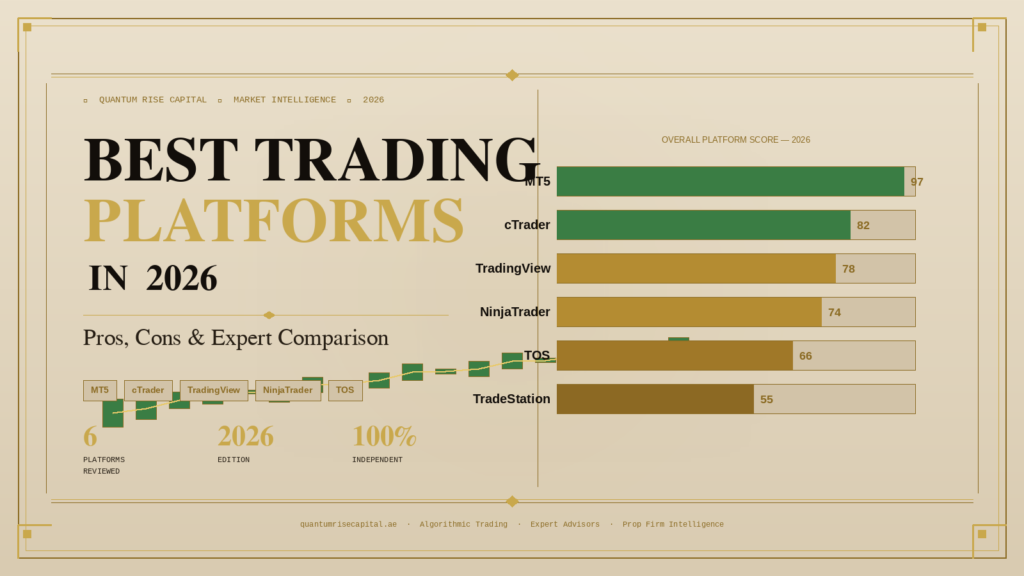
Choosing the best trading platform is one of the most consequential decisions a systematic trader or prop firm challenger makes, and the answer changed more in the last two years than in the ten before. MetaQuotes’ 2024 crackdown pushed prop firms onto other platforms, cTrader added Python, TradingView started hosting prop challenges, and NinjaTrader changed owners. This guide compares MetaTrader 5, cTrader, TradingView, NinjaTrader, Thinkorswim and TradeStation, with honest pros, real cons and a clear verdict on who each one is for.
Why the best trading platform depends on you
The best trading platform isn’t the one with the flashiest dashboard. It’s the one that fits your trading style, the instruments you trade and how your orders need to be executed. Now that algorithmic trading and prop firm challenges are common routes in for retail traders, picking the wrong one costs real money.
If you trade prop firm challenges, the firm decides which platforms you can use, and its rules apply whichever one you pick. FTMO, for example, offers MetaTrader 4, MetaTrader 5, cTrader and TradingView for its forex and CFD challenges, and NinjaTrader, Tradovate and TradingView for futures. Rules on high-frequency trading, news and position sizing are set by the firm, not the platform. Where you live matters too: since 2024 many prop firms can’t offer MetaTrader to US residents.
For algorithmic traders the question narrows further. Does the platform run fully automated strategies? How realistic is its backtesting engine? Does it give you a scripting language or API strong enough for serious risk logic? The gap between platforms that answer yes to all three and those that don’t has widened.
1. MetaTrader 5 (MT5): the best trading platform for EAs
Developer: MetaQuotes · QRC rating ★★★★★ · Best for algo traders and forex/CFD prop challenges
MetaTrader 5 is still the best trading platform for algorithmic trading in forex and CFDs. Its MQL5 language, built-in strategy tester with multi-threaded optimization and broad broker support make it the default choice for EA developers and prop firm challengers. Every Expert Advisor in the QRC fleet is built, optimized and validated on MT5.
Pros:
- MQL5, a full programming language for Expert Advisors and indicators
- Multi-threaded genetic algorithm optimizer built into the strategy tester
- The most widely offered platform at forex and CFD prop firms
- Tick-by-tick backtesting on real ticks, including historical spreads
- Market depth and a built-in economic calendar
- Free, supplied by your broker or prop firm
- Official Python package for pulling data and sending orders
- Netting and hedging account modes
Cons:
- The interface feels dated next to modern web platforms
- MQL5 has a steep learning curve for non-programmers
- The mobile app has limited charting
- Optimizing in the MQL5 Cloud Network costs money
- The strategy tester can’t fully reproduce live slippage
- Many prop firms can’t offer it to US residents
2. cTrader
Developer: Spotware · QRC rating ★★★★☆ · Best for ECN-style execution and C# or Python developers
cTrader is the most credible alternative to MT5 for anyone choosing the best trading platform for forex. Its Algo environment runs automated strategies, called cBots, written in C# and, since cTrader 5.4, in native Python. Execution is transparent, the interface is modern, and prop firm support has grown since the MetaQuotes crackdown, with FTMO and FundingPips both offering it.
Pros:
- Transparent execution with Level II pricing and full order book view
- cBots in C# or Python, two widely used professional languages
- Modern, clean interface with strong charting
- Desktop apps for Windows and Mac, plus web and mobile on one account
- Cloud cBots that can be started and managed from web or mobile
- Built-in copy trading
Cons:
- A smaller broker ecosystem than MT5
- The backtester is less battle-tested than MT5’s
- A much smaller library of ready-made strategies and indicators
- Fewer prop firms offer it than MT5
- Strategy development is desktop-only
3. TradingView
Developer: TradingView Inc. · QRC rating ★★★★☆ · Best for charting and analysis
For charting alone, TradingView is arguably the best trading platform in retail trading, and certainly the most widely used. Its strength isn’t execution. It’s the charts and the community around them. Pine Script, now on version 6 since December 2024, lets traders build custom indicators, strategy backtests and alerts. Broker integrations keep expanding, and FTMO has let traders run simulated challenge trades directly from TradingView charts through OANDA since 2025.
Pros:
- Best-in-class charting with a large built-in indicator library
- Pine Script v6 for custom indicators, strategies and alerts
- A huge community with thousands of free public scripts
- Coverage of forex, stocks, crypto, futures and indices
- Live execution through integrated brokers
- An excellent mobile app
- Strong screeners and alerts
Cons:
- Pine Script isn’t built for complex, fully automated EAs with deep risk logic
- Fully automated trading usually depends on alerts and third-party bridges
- Strategy backtesting is less realistic than MT5 or NinjaTrader
- Paid plans needed for multiple layouts and more indicators per chart
- Real-time data on some markets costs extra
At Quantum Rise Capital we use TradingView for analysis and visualization, particularly macro regime work and index correlation studies on instruments like NAS100 and GER40. All EA execution and optimization runs happen in MetaTrader 5.
4. NinjaTrader
Developer: NinjaTrader Group, part of Kraken since 2025 · QRC rating ★★★★☆ · Best for futures and order flow
For many futures traders, NinjaTrader is the best trading platform available. Kraken completed its acquisition in 2025 and runs it as a standalone platform. NinjaScript, which is C#-based, gives deep programmatic control, and its order flow tools are among the best available to retail traders. For strategies on CME contracts like ES, NQ, CL or GC, it’s the benchmark, and it’s one of the platforms FTMO offers for futures challenges.
Pros:
- Excellent order flow and market depth analysis
- NinjaScript for deep control over automated strategies
- Tick replay for realistic backtesting
- A strong ecosystem of add-ons and data feeds
- A free plan, a $99 monthly plan or a $1,499 lifetime licence that lowers commissions
- Web and mobile apps alongside the desktop platform
Cons:
- Not offered by forex and CFD prop firms
- A steep learning curve if you don’t know C#
- The NinjaTrader 8 desktop platform doesn’t run natively on macOS
- Limited spot forex and no CFDs
- The lifetime licence is a large upfront cost
- A smaller community than MT5 or TradingView
5. Thinkorswim
Developer: Charles Schwab · QRC rating ★★★★☆ · Best for US equities and options
Thinkorswim is now fully part of Schwab after the TD Ameritrade integration, and for many US equity and options traders it’s still the best trading platform they can get for free. Its options analytics and paper trading are excellent, and its thinkScript language drives custom studies, scans and conditional orders.
Pros:
- Free with a Schwab brokerage account
- Some of the best options chain and probability tools anywhere
- Full paper trading on real market data
- thinkScript for custom studies, scans and alerts
- Broad coverage of US equities, options and futures
- Solid desktop, web and mobile versions
Cons:
- No fully automated strategy execution of the kind MT5 or NinjaTrader offers
- No CFDs and little for crypto
- thinkScript is limited compared with MQL5 or NinjaScript
- Availability outside the US depends on your country through Schwab International
- No prop firm challenge support
6. TradeStation
Developer: TradeStation Group · QRC rating ★★★☆☆ · Best for backtesting US equities
TradeStation is a combined broker and platform built for active, systematic US traders. EasyLanguage has been a staple of retail algorithmic trading for decades, and the platform’s historical data on US equities and futures runs deep. Its relevance has faded as more modern platforms have arrived.
Pros:
- Decades of historical data on US equities and futures
- EasyLanguage, one of the longest-running retail strategy languages
- A well-regarded optimizer for equity strategies
- Integrated brokerage with direct market access
- Stocks, options and futures in one account
Cons:
- EasyLanguage feels dated, and the community is smaller than MT5’s or TradingView’s
- Inactivity fees on some accounts
- Available to non-US residents only in some countries, with a narrower product range
- No forex or CFD broker ecosystem and no prop firm support
- A weaker mobile app than its competitors
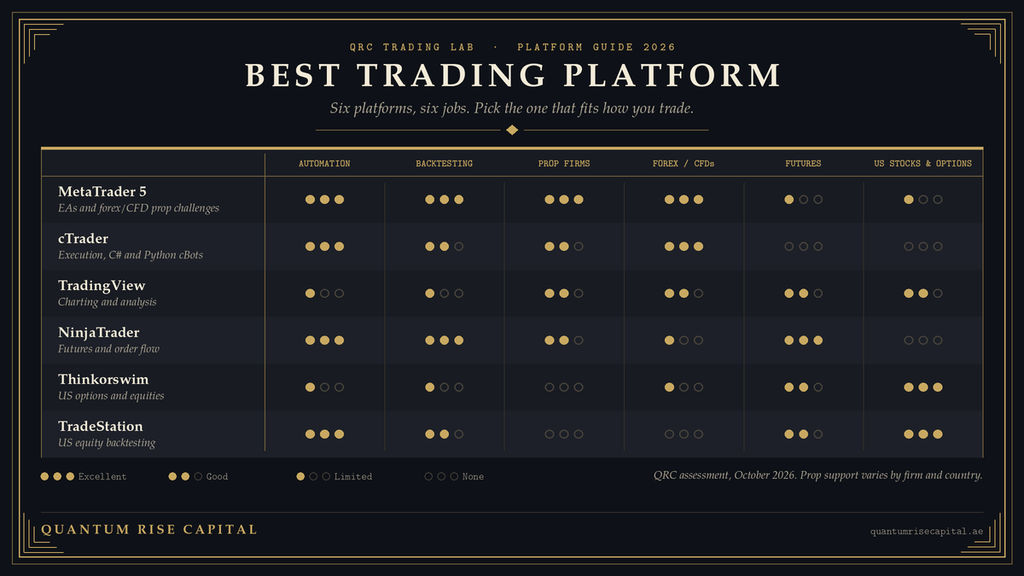
Full comparison: the best trading platform for each job
| Platform | Automation | Language | Prop firm support | Forex / CFDs | Futures | US equities & options | Cost | Best for |
|---|---|---|---|---|---|---|---|---|
| MetaTrader 5 | Full EAs | MQL5 | Widest (forex/CFD) | Excellent | Broker-dependent | Limited | Free via broker | EAs, prop challenges |
| cTrader | Full cBots | C#, Python | Growing | Excellent | No | No | Free via broker | Execution, C#/Python devs |
| TradingView | Alerts, partial | Pine Script v6 | Some (incl. FTMO) | Via brokers | Via brokers | Via brokers | Free tier, paid plans | Charting, analysis |
| NinjaTrader | Full strategies | NinjaScript (C#) | Futures firms | Limited | Excellent | No | Free, $99/mo or $1,499 | Futures, order flow |
| Thinkorswim | Conditional orders | thinkScript | None | Limited | Good | Excellent | Free with Schwab | US options, equities |
| TradeStation | Full strategies | EasyLanguage | None | No | Good | Excellent | Commissions, fees vary | US equity backtesting |
Which is the best trading platform for you?
It depends on what you trade and how. No single best trading platform wins everywhere, but each use case has a clear leader.
If you’re an algorithmic trader or prop firm challenger in forex and CFDs, especially if you run Expert Advisors, MetaTrader 5 is the best trading platform by a wide margin. Its strategy tester, MQL5 and broad prop firm support give it an advantage nothing else matches yet. Check first that your firm can offer it in your country.
If you want transparent execution and you’d rather write code in C# or Python, cTrader is the strongest alternative, especially for rules-based strategies that don’t rely on grids.
For chart analysis and macro research across asset classes, TradingView is the essential companion in any serious trader’s setup. Run it alongside your execution platform, not instead of it.
NinjaTrader is the top choice for futures traders who need serious order flow tools, and it’s now a route into futures prop challenges as well.
If you’re US-based and focused on equities and options, Thinkorswim gives you professional-grade tools for free, which is hard to beat.
Moving between platforms with QRC tools
Your choice of the best trading platform doesn’t have to lock in your strategy. QRC Strategy Architect generates native code for MetaTrader 5, MetaTrader 4 and cTrader from a multiple-choice questionnaire, so the same trading idea can run on whichever platform your prop firm offers. QRC Lodestar validates optimization results from MT4 and MT5, and also reads results tables from cTrader, NinjaTrader and TradingView, so you can check whether an edge is real before you trust it on any of them.
Want a system built for your platform and your prop firm?
The best trading platform is only half the decision. The other half is a strategy whose risk layer matches your prop firm’s rules on that platform: daily loss calculated the way the firm calculates it, a maximum loss guard and position sizing that shrinks as headroom does. QRC builds tailored trading systems on MetaTrader 5 around your strategy and your target firm’s rules, validated before you pay for a challenge.
See what we offer on our services page: https://www.quantumrisecapital.ae/our-services/
At Quantum Rise Capital, our own trading infrastructure runs on MetaTrader 5. For traders working through prop firm challenges in 2026, it’s still the most reliable, most widely supported and most flexible platform for algorithmic trading.
Platform features, prices and prop firm support change often. Details here reflect each provider’s published information and public reporting at the time of writing. Trading leveraged products carries a high risk of loss.
Sources:
- FTMO: Which platforms can I use for trading?
- FTMO Futures trading platforms
- Finance Magnates: Eightcap brings challenges to TradingView, following FTMO
- Finance Magnates: MetaQuotes, FundingPips and MT access for US clients
- FX News Group: Funded Engineer closes, files for bankruptcy
- Spotware: cTrader native Python support
- cTrader platforms FAQ
- TradingView: Pine Script v6 has landed
- Business Wire: Kraken completes acquisition of NinjaTrader
- StockBrokers.com: NinjaTrader review
- Schwab International
- BrokerChooser: TradeStation for non-US residents
- MQL5: Python integration
