Almost every EA that dies in its first week of live trading looked spectacular in the tester. That is not a coincidence. It is the whole problem with Backtests.
An optimizer will hand you a parameter set that turned $10,000 into $80,000 over two years of history, with a profit factor north of 3 and a drawdown that looks almost polite. You go live. Three weeks later the account is bleeding and you cannot work out what changed. Nothing changed. The market kept doing what it always does. The backtest was never describing an edge. It was describing a coincidence that already happened and will not happen again in the same shape. This is why understanding Backtests is crucial.
That coincidence has a name: overfitting. It is the single biggest reason profitable-looking systems blow funded accounts, and most traders never see it coming because the numbers look so good on the way in. The truth behind Backtests reveals this harsh reality.
What overfitting actually is
Understanding the Importance of Backtests
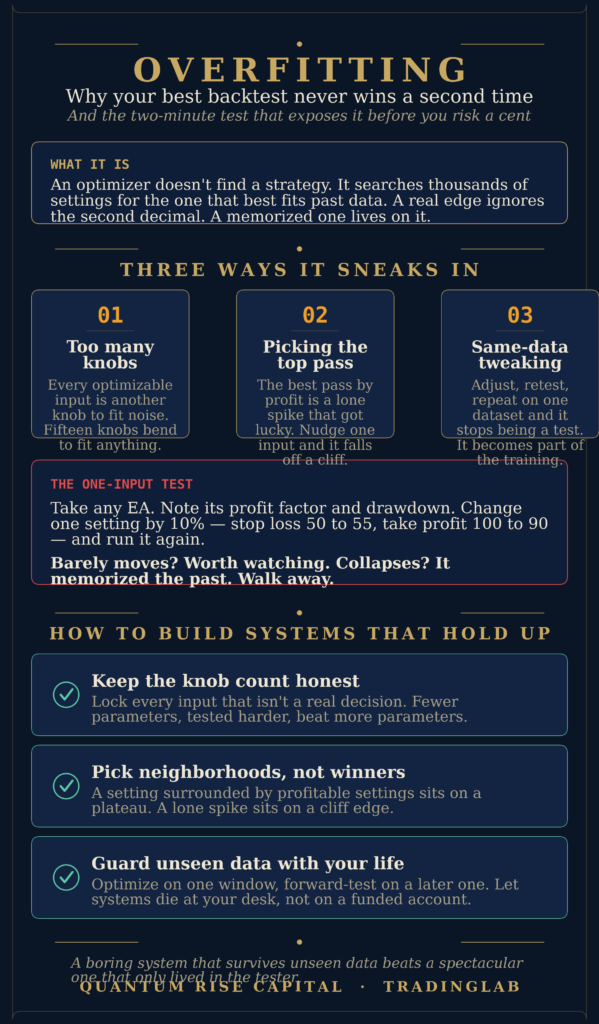
When you run a genetic optimization in MetaTrader 5, you are not finding a strategy. You are searching thousands of parameter combinations for the one that best fits a specific stretch of price history. Given enough combinations, the optimizer will always find something that fits beautifully. It has to. With enough knobs to turn, you can fit almost any curve to almost any data.
The trouble is that “fits this history best” and “will make money next month” are two completely different things, and the optimizer only knows how to chase the first one.
Think about what a stop loss of exactly 47 pips means. If 47 is the number that produced the best backtest, and 45 or 50 produce far worse results, then your system did not discover something true about the market. It discovered that on this particular data, trades that were cut at exactly 47 pips happened to survive a few moves that trades cut at 45 did not. That is memorization. The market will never reproduce those exact moves at those exact levels again, so the magic number stops being magic the moment you go live.
A real edge does not care about the second decimal place. If your strategy only works at 47 pips and falls apart at 45, you do not have a strategy. You have a very expensive way of describing the past.
How it sneaks in
Overfitting rarely arrives as one obvious mistake. It builds up quietly, one reasonable-looking decision at a time.
The most common way is simply optimizing too many parameters at once. Every input you let the optimizer tune is another degree of freedom, another knob it can twist to fit the noise instead of the signal. An EA with fifteen optimizable inputs will produce a gorgeous backtest almost regardless of whether the underlying idea has any merit, because fifteen knobs can bend to fit anything. Fewer inputs, tested harder, beat more inputs every time.
The second way is running the optimizer, taking the top result by net profit, and going live with it. This one feels responsible because you “optimized.” It is the opposite. The top pass by profit is almost always a statistical outlier, a lone spike that got lucky on this exact data. It sits by itself, surrounded by nothing. Nudge any of its inputs slightly and the whole thing falls off a cliff.
The third way is subtler and harder to catch. You test on a stretch of history, get a mediocre result, tweak the logic, test again on the same history, and repeat until it looks good. Each tweak was made with knowledge of how that data behaved. By the time you are happy, you have not built a strategy that works on unseen markets. You have hand-fitted your logic to that one dataset through dozens of small adjustments. The data is no longer a test. It became part of the training, and you have nothing left to check yourself against.
The one-input test anyone can run
You do not need clustering or statistics to catch the worst offenders. There is a check that takes two minutes and exposes most overfit systems on the spot.
Take the EA you are thinking of trading, whether you built it or bought it. Run its backtest and note the profit factor and drawdown. Now change one setting by a small amount. Stop loss from 50 to 55. Take profit from 100 to 90. One number, one small nudge, nothing dramatic.
Run it again and look at what happened.
If the results barely move, you have something worth taking seriously. The curve shifted a little because the inputs shifted a little, which is exactly how a real edge behaves. But if a 10% change to a single input collapses the profit factor or doubles the drawdown, that EA did not find an edge. It memorized a specific slice of price history that will never repeat, and you just watched it fail the moment reality moved by more than a rounding error.
The market will do far worse than 10% to your settings on any ordinary Tuesday. If your system cannot survive you nudging one number at your desk, it has no chance against a spread that widens at the worst moment or a fill that comes in slower than the tester ever assumed.
Building systems that hold up
Avoiding overfitting is mostly about refusing to trust a single number, and building your whole process around that refusal.
Start by keeping your parameter count honest. Before you let the optimizer touch an input, ask whether it represents a real decision the strategy has to make, or whether you are just giving the tester another knob to fit noise. Lock everything that does not need to move. At QRC we keep all risk and compliance parameters fixed as static inputs so the optimizer can never “improve” the backtest by quietly loosening the risk controls. The fewer things you optimize, the harder it is to fool yourself.
Then stop picking winners and start picking neighborhoods. Instead of taking the single best pass, look at the region of parameter space around it. A parameter set surrounded by other profitable parameter sets is sitting on a plateau, and plateaus have room to absorb the market doing something unexpected. A lone profitable spike with poor results on every side is sitting on a cliff edge. When conditions shift, and they always do, the plateau bends where the cliff simply collapses. That is why our optimization pipeline works from stable regions of the results rather than cherry-picking the top row of the report.
Most importantly, keep data your system has never seen and never let it touch that data until the very end. Optimize on one window, then forward-test on a later window the optimizer never saw. If the system falls apart on that unseen data, it dies there, at your desk, on your terms. That is the entire point. You want your strategies to fail in testing where it costs nothing, not live where it costs a funded account. A system that survives genuinely out-of-sample data has at least earned the right to a small live trial. A system that only shines on the data it was optimized on has told you nothing except that optimizers are good at their job.
Learn to distrust a good-looking curve
Overfitting is dangerous because it always looks like success. The curve goes up and to the right, the metrics are gorgeous, and every instinct tells you that you have found something. The whole discipline is in distrusting that feeling precisely when it is strongest.
A boring, stable system that made steady money across several unseen windows is worth far more than a spectacular one that only ever existed inside the optimizer. The spectacular one is not a strategy. It is a screenshot, and screenshots do not survive contact with a live market.
So before you risk a cent on any EA, nudge one input and watch what happens. Two minutes at your desk can save you a blown challenge and a month of wondering what went wrong.
