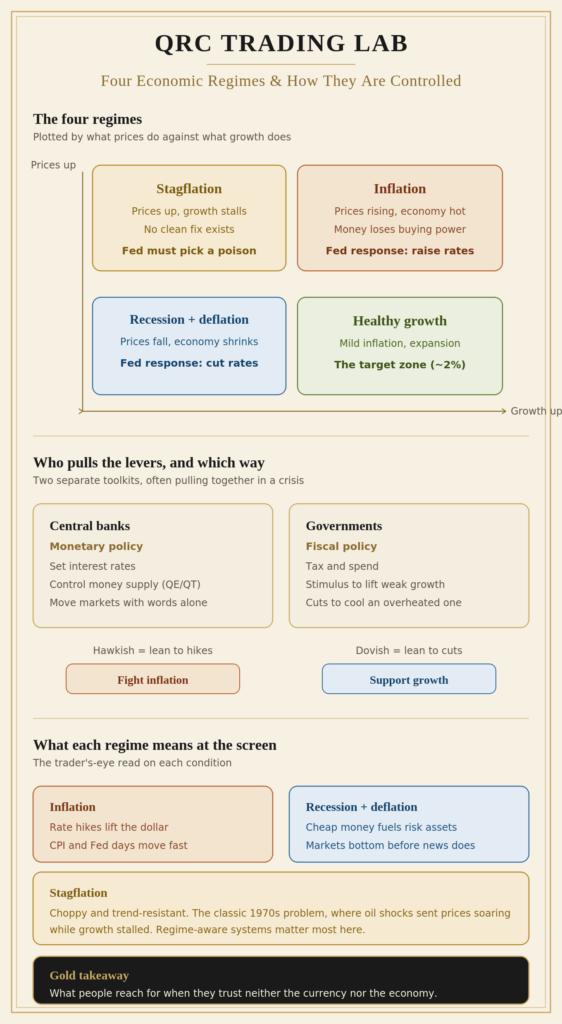
Every trader eventually learns that price charts don’t move in a vacuum. Behind every breakout on gold or every grind on the indices sits a machine of central banks, governments, and millions of people deciding whether to spend or hoard. Four words sit at the center of that machine: inflation, deflation, stagflation, and recession. Get a feel for what they actually mean and how the people in charge try to steer them, and a lot of market behavior stops looking random.
I want to walk through each one the way it actually shows up on a screen, not the textbook way.
Inflation: money loses its grip
Inflation is the slow leak in your currency. When prices across the economy climb, each dirham, dollar, or euro buys a little less than it did last month. A bit of it is normal and even healthy. Central banks usually aim for something around 2% a year, because mild inflation nudges people to spend and invest rather than sit on cash that’s quietly losing value.
The trouble starts when it runs hot. When inflation spikes, the people who control money supply step in, and that’s where it matters for trading.
The main tool is the interest rate. When the US Federal Reserve raises rates, borrowing gets more expensive, businesses slow down their expansion, consumers pull back, and the heat comes out of prices. Higher rates also tend to strengthen the dollar, because money flows toward currencies that pay more to hold. That single mechanism ripples through everything: a stronger dollar usually pressures gold, weighs on emerging market currencies, and can spook equity indices that were running on cheap debt.
For anyone trading XAUUSD, inflation data is not background noise. Gold has a long history as an inflation hedge, but the relationship is messier than the slogans suggest. Gold often rises when inflation is feared and real rates are low, then gets slammed the moment the Fed signals aggressive hikes, because suddenly holding cash pays again and gold pays nothing. The CPI release and the Fed meeting are two of the most violent scheduled events on the calendar for a reason.
Deflation: the opposite problem, and arguably the scarier one
Deflation is when prices fall across the board. Sounds great if you’re shopping. It’s a nightmare for an economy.
Here’s why. If you expect a TV to be cheaper next month, you wait. If everyone waits, demand collapses, companies cut prices further to move stock, then they cut wages or jobs to survive, then people have even less to spend, and the cycle feeds itself downward. Debt also gets heavier in real terms, because you’re paying back loans with money that’s now worth more than when you borrowed it. Japan spent the better part of two decades stuck in this trap.
Central banks fight deflation by going the other direction: cutting rates, sometimes to zero or below, and pumping money into the system through bond buying, which markets know as quantitative easing. For traders, a deflationary scare followed by central bank stimulus has historically been rocket fuel for risk assets. Cheap money has to go somewhere, and it tends to find its way into stocks, crypto, and eventually gold.
Recession: the economy contracts
A recession is the broad slowdown. The common shorthand is two consecutive quarters of shrinking GDP, though the people who officially call recessions look at a wider mix of employment, spending, and income data.
What causes them varies. Sometimes it’s a central bank deliberately cooling an overheated economy and overshooting. Sometimes it’s a shock, like a credit crisis or a pandemic. Either way, the response is fairly predictable: the Fed cuts rates to make borrowing cheap again, and governments often open the spending taps with stimulus checks, tax cuts, or infrastructure programs. Monetary policy comes from the central bank, fiscal policy comes from the government, and in a serious downturn they usually pull in the same direction.
Markets are forward looking, which trips up a lot of newer traders. Equities often bottom and start climbing while the news is still terrible and unemployment is still rising, because traders are pricing in the recovery they expect from all that stimulus. Trading the headlines during a recession is a good way to be perpetually late. The smart money is positioning for what rates will do six months out, not reacting to yesterday’s GDP print.
Stagflation: the one nobody has a clean answer for
Now the awkward combination. Stagflation is high inflation and a stagnant economy at the same time, usually with rising unemployment thrown in. It breaks the normal playbook.
The reason it’s so nasty: the standard fix for inflation is to raise rates, and the standard fix for a weak economy is to cut them. In stagflation you can’t do both. Raise rates to kill inflation and you choke an already weak economy into recession. Cut rates to help growth and you pour fuel on inflation. Central banks end up choosing which problem to lose to. The classic example is the 1970s, when oil shocks sent prices soaring while growth stalled, and it took brutally high interest rates to finally break it.
For a trader, stagflation environments tend to be choppy and trend-resistant, which is part of why regime-aware systems matter. The asset that historically does well here is gold, precisely because it doesn’t depend on corporate earnings or low rates to justify its existence. It’s the asset people reach for when they don’t trust either the currency or the economy.
Who’s actually pulling the levers
Central banks are the front line. The Federal Reserve in the US, the European Central Bank, the Bank of England, the Bank of Japan. They set short term interest rates, control the money supply, and run programs that expand or shrink their balance sheets. When you hear that a central bank is “hawkish,” it’s leaning toward higher rates to fight inflation. “Dovish” means it’s leaning toward cuts to support growth. Those two words move billions before a single rate is changed, because markets trade the expectation, not just the event.
Governments handle the fiscal side: taxes and spending. They can stimulate a weak economy by spending more or taxing less, or cool an overheated one by doing the reverse, though in practice politicians rarely enjoy applying the brakes.
And then there’s the part the textbooks underplay: a huge amount of central bank power is just talk. Forward guidance, where officials hint at what they’ll do next, often moves markets more than the actual decision. A Fed chair choosing the word “patient” instead of “vigilant” in a press conference can swing gold fifty dollars in minutes. As a trader, you’re not just trading the economy. You’re trading what a small group of people are expected to do about it.
Pulling it together
These four conditions aren’t separate boxes. They flow into each other. Too much stimulus fighting a recession can tip into inflation. Slamming the brakes on inflation can trigger a recession. A supply shock can drag you into stagflation from almost anywhere. The central banks steering all of this are working with blunt tools and a delay of many months before their actions show up in the data, which is exactly why they get it wrong often enough to create the volatility we trade.
You don’t need to predict any of it perfectly. What helps is knowing which regime you’re likely in, what the people in charge are probably about to do about it, and how your instrument tends to behave when they do. That’s the difference between getting blindsided by a CPI release and being positioned for it.
