A profitable backtest is attractive. A profitable live month is even more convincing.
But neither, by itself, proves that you have a good trading system.
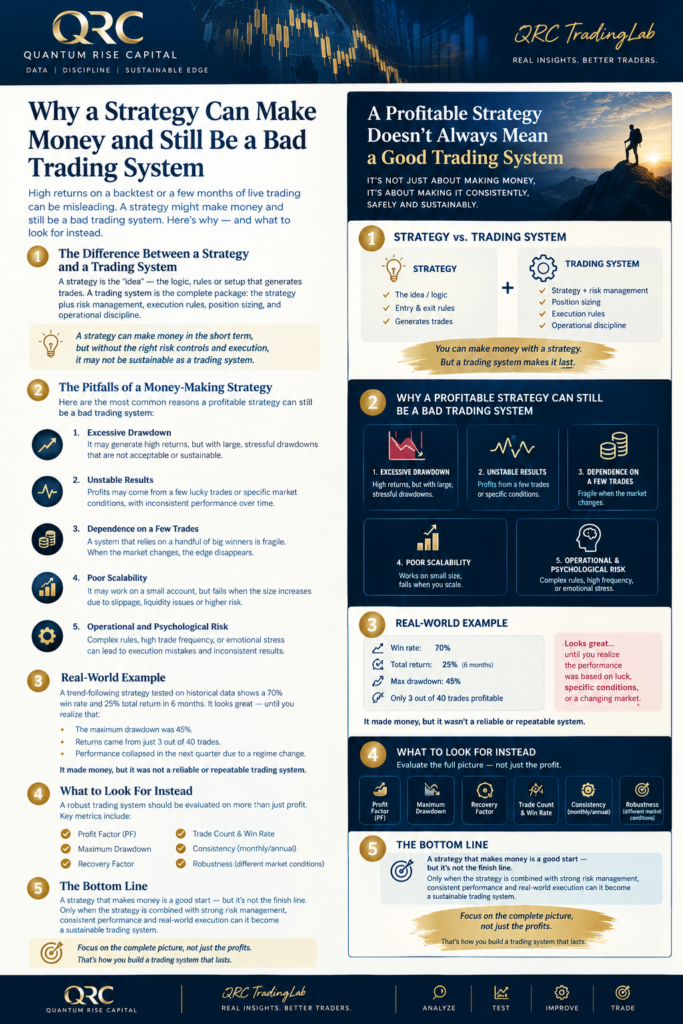
One of the most common mistakes in algorithmic and systematic trading is confusing profitability with robustness. A strategy can generate impressive returns and still be fragile, difficult to scale, excessively risky, or completely dependent on a particular market environment.
The important question is therefore not simply:
“Did it make money?”
It is:
“Why did it make money, and can that behavior reasonably survive?”
1. A Strategy Is Not the Same as a Trading System
A strategy is the trading idea or logic.
It defines things such as:
- When to enter
- When to exit
- Which market conditions to trade
- Which signals to use
A trading system is the complete operational framework around that strategy.
It also includes:
- Risk management
- Position sizing
- Drawdown controls
- Execution rules
- Exposure limits
- Daily and overall loss limits
- Operational procedures
- Monitoring and failure controls
This distinction matters.
A strategy may have a genuine statistical edge, but poor position sizing can destroy the account. Conversely, a modest strategy can become a much more practical system when combined with disciplined risk management and robust execution.
The strategy generates the opportunity. The system determines how safely that opportunity is exploited.
2. How Can a Profitable Strategy Still Be Bad?
1. Excessive Drawdown
A system can make 40% while experiencing a 35% drawdown.
On paper, that may look profitable.
In practice, the path matters.
Large drawdowns increase:
- Capital requirements
- Psychological pressure
- Risk of forced intervention
- Probability of abandoning the system at the worst possible moment
Return without understanding the path taken to achieve it is incomplete information.
2. Unstable Results
Suppose most of the annual profit comes from two exceptional months while the remaining ten months produce little or negative performance.
The headline return may look impressive.
But the underlying behavior may be unstable.
A stronger evaluation asks:
Is the performance distributed reasonably across time, trades and market conditions?
3. Dependence on a Few Trades
A system that makes most of its money from three or four exceptional trades can be surprisingly fragile.
Remove those trades and the entire performance profile may change.
This is why trade distribution matters.
Look beyond total profit and examine:
- Number of trades
- Average trade
- Largest winners
- Largest losers
- Profit concentration
- Monthly contribution
A good-looking equity curve can hide a surprisingly narrow source of profitability.
4. Poor Scalability
A strategy might work perfectly with $1,000 and behave differently with $100,000.
As position size increases, other variables become important:
- Slippage
- Liquidity
- Market impact
- Spread
- Execution speed
- Broker limitations
A strategy that is profitable at small size is not automatically scalable.
Capital capacity is part of system quality.
5. Operational Risk
Some strategies are technically profitable but operationally difficult.
Consider a system requiring:
- Very frequent intervention
- Complex manual decisions
- Constant monitoring
- Extremely precise execution
- Multiple external data sources
The mathematical edge may be real, but the operational burden can make the system unreliable in practice.
A trading system must survive contact with reality—not just a backtest engine.
3. A Simple Example
Imagine a strategy with:
70% win rate
25% return over six months
At first glance, this looks excellent.
Now examine the underlying statistics:
- Maximum drawdown: 45%
- Only 3 of 40 trades generated most of the profit
- Performance deteriorated after a market-regime change
- Position size cannot be increased without significantly affecting execution
The strategy made money.
But that does not necessarily make it a reliable trading system.
The distinction is important:
Profitable ≠ robust.
4. What Should You Evaluate Instead?
Profit should be one metric inside a larger framework.
A more complete evaluation includes:
Profit Factor
How much gross profit is generated relative to gross loss?
Maximum Drawdown
How much adverse movement did the strategy experience?
Recovery Factor
How effectively did the system recover from drawdowns?
Trade Count and Distribution
Is the result based on a meaningful number of observations?
Consistency
Are returns reasonably distributed across months and periods?
Robustness
Does the strategy continue to behave acceptably under different market conditions and reasonable parameter variations?
Execution
Does the theoretical edge survive spreads, slippage and real trading conditions?
Scalability
Can the strategy handle larger capital without materially changing its behavior?
No single metric answers all of these questions.
That is precisely the point.
5. The Difference Between a Good Backtest and a Good System
A backtest answers:
“What happened under these historical assumptions?”
A robust development process asks additional questions:
Does the strategy work on unseen data?
Does it survive forward testing?
Does performance remain acceptable when parameters are slightly changed?
Does it work across different market regimes?
Does execution materially change the expected outcome?
Can the risk be controlled when things go wrong?
These questions move the evaluation from performance chasing toward system engineering.
6. The Bottom Line
A strategy that makes money is a good starting point.
It is not the finish line.
The objective should not be to find the strategy with the highest historical return.
The objective is to identify a system whose:
edge + risk management + execution + robustness + operational discipline
can work together consistently.
At QRC TradingLab, we believe the important question is not:
“How much did it make?”
It is:
“How reliable is the process that produced those returns?”
Because in systematic trading, the most dangerous system is not necessarily the one that loses money.
Sometimes, it is the one that makes money just convincingly enough to hide how fragile it really is.
Check our QRC Strategy Architect tool, an AI tool could help you create your own trading strategy: QRC Strategy Architect – Quantum Rise Capital (QRC)
